The post Freight Audit And Payment Has Become a Financial Control Function appeared first on nVision Global | Worldwide Supply Chain Solutions, Specializing in Global Freight Audit & Payment, Loss & Damage Claims, Supply Chain Services & Technology.
]]>
Freight audit and payment has often been viewed as a back-office process. For many companies, the goal was simple: review transportation provider invoices, identify errors, resolve discrepancies, and make sure payments were processed correctly.
That work still matters. In fact, it may matter more than ever. But the role of freight audit and payment has changed.
Today, freight audit is no longer just about recovering overcharges after they happen. It is becoming a financial control function that protects margin, improves visibility into transportation spend, supports better forecasting, and gives leadership greater confidence in the numbers behind one of the company’s largest operating expenses.
For enterprise shippers, transportation spend is too large, too complex, and too volatile to treat as a transactional process alone. Every invoice contains financial signals. Every exception creates potential exposure. Every dispute, surcharge, accessorial, rate mismatch, or documentation gap can affect cost, reporting accuracy, accruals, and business decisions.
That is why freight audit and payment must now be viewed through a broader financial lens.
Transportation Spend Is a Financial Control Issue
Transportation costs move through the business in many ways. They impact cost of goods sold, operating budgets, customer profitability, cash flow, accruals, margin analysis, and procurement strategy. Yet for many companies, the data behind those costs is fragmented across systems, locations, modes, regions, business units, and transportation providers.
That creates risk.
When freight invoices are not properly validated, companies may pay incorrect charges. When accessorials are not clearly reviewed, unexpected costs can become normalized. When contracted rates are not consistently matched against actual invoice charges, savings negotiated by procurement may never fully materialize. When data is incomplete or inconsistent, finance teams may struggle to trust the numbers used for reporting and forecasting.
In that environment, freight audit becomes much more than invoice review. It becomes a control point.
A strong freight audit and payment program helps ensure that transportation spend is accurate, documented, governed, and connected to the financial processes that depend on it. It creates structure around a cost category that is constantly changing and often difficult to manage.
The Old View: Find Errors and Recover Money
Historically, freight audit was often measured by how much money it recovered. Duplicate invoices, incorrect rates, misapplied discounts, invalid accessorials, fuel surcharge errors, and service-level mismatches were identified and disputed. The value was easy to understand: find the overcharge, prevent the payment, or recover the funds.
That remains an important part of the process. But recovery alone is not enough.
A recovery-focused model is reactive by nature. It addresses problems after they have already entered the system. It may correct individual invoices, but it does not always help the organization understand why those errors are happening, where they are concentrated, which business units are most affected, or how they connect to broader transportation strategy.
Modern freight audit must go further.
The real value is not only in identifying what went wrong. It is in creating the controls, data discipline, and visibility needed to prevent recurring issues, improve decision-making, and strengthen financial confidence across the organization.
The Numbers Behind the Risk
The need for freight audit is not theoretical. Across all transportation modes and global regions, nVision Global routinely identifies billing discrepancies during the audit process. Depending on the transportation mode and region, discrepancies are found on approximately one out of every 23 invoices to as many as one out of every 6 invoices submitted for audit. Overall, nVision’s historical experience is approximately one finding for every 10 invoices audited.
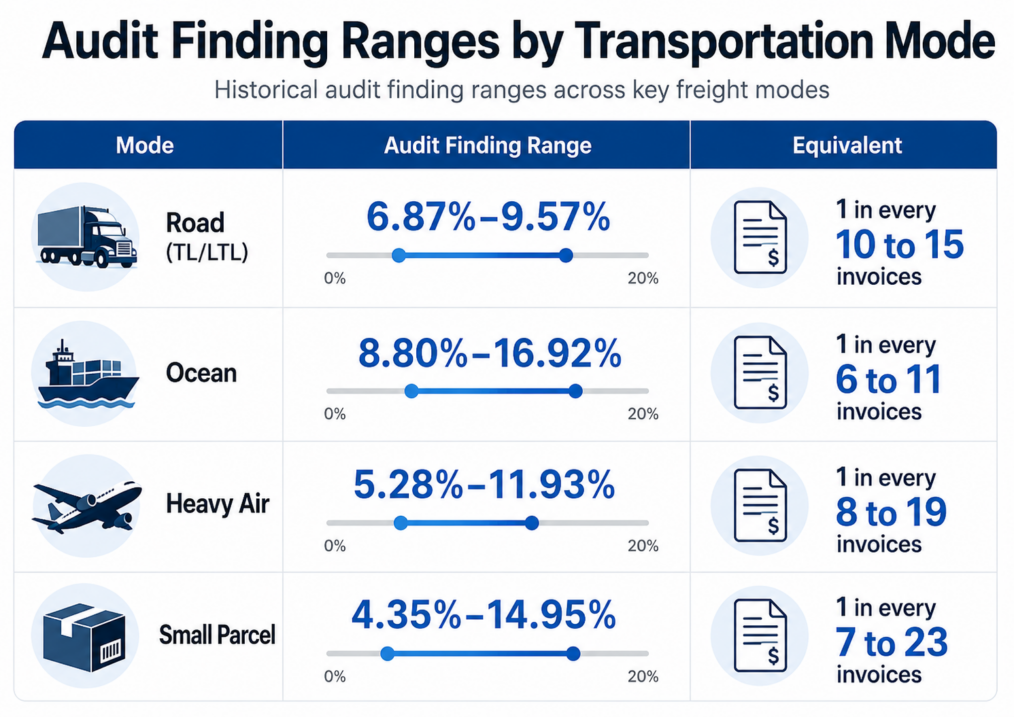
These findings help explain why freight audit and payment has historically been so important. They also show why the discipline is expanding. Each discrepancy is not only a potential recovery or prevention opportunity; it is also a data point that can reveal patterns by carrier, lane, mode, region, business unit, accessorial type, contract term, or approval process.
The New View: Protect Margin and Improve Confidence
In today’s transportation environment, costs can shift quickly. Fuel volatility, changing demand, capacity constraints, accessorial growth, global disruption, regulatory changes, and transportation provider variability can all create financial pressure.
Small invoice errors may not appear significant on their own. But across thousands or millions of shipments, small errors become real money. A misapplied surcharge, an incorrect rate table, a duplicate charge, or an unchallenged exception can quietly erode margin over time.
nVision Global’s financial control and governance metrics reinforce that point. The company’s 9.55% average audit finding rate means that approximately one in every 10 invoices contains at least one billing discrepancy. Across all transportation modes and global regions, the average financial adjustment per audit finding is $183.54, and in 2025, nVision identified more than $360 million in transportation financial adjustments.
This is where freight audit becomes a margin protection function.
By validating freight invoices before payment, companies can reduce leakage and improve control over transportation spend. By organizing invoice-level data into accurate reporting, they can better understand cost trends, provider performance, accessorial exposure, and budget variance. By connecting freight data to finance, procurement, and supply chain decisions, they can move from reacting to spend toward actively managing it.
The result is not just cleaner invoices. The result is greater confidence.
Finance can trust the transportation numbers used in reporting. Procurement can evaluate whether negotiated savings are actually being realized. Supply chain leaders can see where cost exceptions are occurring. Executives can make decisions based on validated data rather than disconnected estimates.
Freight Data Has Financial Data
Freight invoices are often treated as payment documents. But they are also data assets.
Each invoice can contain shipment details, origin and destination information, service levels, modes, weights, zones, rates, discounts, surcharges, accessorials, taxes, duties, provider information, payment terms, and exception details. When that information is captured, validated, standardized, and analyzed, it becomes a source of transportation financial intelligence.
But that intelligence depends on the quality of the data.
If invoice data is inaccurate, incomplete, or inconsistent, the reporting built on top of it will be unreliable. If data is not governed properly, different teams may use different numbers to answer the same financial questions. If upstream processes are not controlled, downstream reporting and analytics become harder to trust.
That is why freight audit and payment plays such an important role.
It sits at the intersection of transportation execution, financial accuracy, provider compliance, and business intelligence. It is one of the few areas where operational activity and financial truth can be reconciled at the transaction level.
Better Controls Create Better Decisions
A modern freight audit and payment program should help answer important business questions, including:
- Are we paying according to our contracted rates?
- Which transportation providers, lanes, modes, or regions are creating the most exceptions?
- Where are accessorial charges increasing
- Are negotiated savings being captured?
- Are certain locations or business units driving unexpected costs?
- Are payment processes aligned with internal financial controls?
- Do finance, procurement, and logistics have access to the same trusted transportation spend data?
These questions go beyond invoice processing. They support financial governance.
The stronger the freight audit process, the stronger the company’s ability to understand and manage transportation spend. Clean data leads to better reporting. Better reporting leads to better decisions.
Better decisions lead to improved financial outcomes.
That is the larger opportunity. Audit findings can identify more than overcharges; they can point to cost reduction opportunities, contract improvement opportunities, procurement opportunities, provider performance opportunities, process improvement opportunities, compliance and governance opportunities, customer service opportunities, and working capital opportunities.
Automation Helps, but Governance Matters
Technology has transformed freight audit and payment. Automation, OCR, EDI, APIs, business rules, machine learning, and analytics can all improve speed, scale, and accuracy.
But technology alone does not create control.
The value comes from how technology is applied. Freight audit requires clear rules, accurate rate data, provider compliance, exception workflows, documentation standards, reporting discipline, and experienced professionals who understand the realities of transportation billing.
AI and automation can help identify patterns, flag anomalies, process documents, and improve efficiency. But those tools must operate within a governed framework. Without strong controls, automation can simply move bad data faster.
That is why the future of freight audit is not automation alone. It is automation supported by governance, expertise, and financial discipline.
The operational metrics matter because they show how technology and governance work together. nVision Global reports:
- 99.3% nSure AI Data Capture Accuracy
- 94.4% Automated Audit Success Rate
- 93.4% Fully Automated Processing with no manual intervention required
- 98.7% Successful EDI Transmission Rate
- 99.1% System Availability YTD
- 93.8% First-Pass Processing Success
- 96.8% Invoice Documentation Compliance
These numbers are not just technology statistics. They support the broader financial control environment by improving data capture quality, processing consistency, documentation discipline, EDI reliability, and workflow confidence.
Freight Audit as a Strategic Business Function
As transportation networks become more complex, the expectations placed on freight audit and payment will continue to grow.
Companies need more than invoice processing. They need accurate financial data. They need visibility into cost drivers. They need controls that reduce leakage. They need confidence that transportation spend is being reviewed, validated, and managed properly.
That shift changes the role of freight audit.
It is no longer just a service that helps accounts payable process invoices. It is a strategic function that supports finance, logistics, procurement, and executive leadership. It helps turn transportation spend into trusted business intelligence.
For companies managing significant freight spend, this evolution is not optional. Transportation costs are too important to leave unmanaged, unvalidated, or disconnected from financial decision-making.
The Bottom Line
Freight audit and payment has become a financial control function because transportation spend has become too complex and too financially significant to manage reactively.
The companies that treat freight audit as a simple transactional process may continue to find and correct individual invoice errors. But the companies that treat it as a control function will gain something more valuable: cleaner data, stronger governance, better visibility, improved margin protection, opportunity identification, and greater confidence in transportation spend decisions.
In today’s environment, freight audit is not just about what was overcharged.
It is about what your transportation data can tell you, what your financial controls can prevent, and how confidently your business can act on the numbers behind your freight spend.
nVision Global helps companies move beyond traditional freight audit and payment by combining technology, transportation expertise, global operations, and business intelligence to create greater control over transportation spend. With accurate data, disciplined processes, and actionable insights, organizations can better protect margin, improve financial confidence, and make smarter decisions across their transportation network.
To learn how nVision Global can help strengthen your freight audit and payment process, contact our team today.
The post Freight Audit And Payment Has Become a Financial Control Function appeared first on nVision Global | Worldwide Supply Chain Solutions, Specializing in Global Freight Audit & Payment, Loss & Damage Claims, Supply Chain Services & Technology.
]]>The post Why Automated Freight Invoice Validation Outperforms Manual Review appeared first on nVision Global | Worldwide Supply Chain Solutions, Specializing in Global Freight Audit & Payment, Loss & Damage Claims, Supply Chain Services & Technology.
]]>
Freight invoices have become too complex, too variable, and too high-volume for manual review alone.
For many companies, transportation invoices are still reviewed through a combination of internal processes, spreadsheets, email approvals, manual checks, and human judgment. While experienced people remain essential to freight audit and payment, the reality is that the human eye was never designed to consistently review thousands, or even millions, of freight invoice details across multiple transportation providers, modes, regions, currencies, contracts, fuel tables, accessorial charges, tax rules, and service requirements.
That is where automated freight invoice validation delivers measurable value.
Automated invoice validation helps shippers move beyond basic invoice processing. It allows transportation charges to be checked against contracted rates, shipment data, business rules, surcharge agreements, approval workflows, and historical patterns before payment occurs. The result is a more disciplined approach to freight audit, transportation spend control, and financial accuracy.
For logistics, supply chain, procurement, and finance teams, this matters because every incorrect charge that slips through the process can affect margin, reporting, cash flow, and provider accountability.
The Problem With Manual Freight Invoice Review
Manual freight invoice review is not ineffective because people are careless. It is ineffective because modern freight billing is incredibly complex.
A single freight invoice may include linehaul charges, fuel surcharges, accessorial fees, dimensional weight calculations, minimum charges, detention, demurrage, storage, reclassification, currency conversion, taxes, duties, special handling charges, and other cost variables. Each of those charges may be tied to a different contract term, shipment characteristic, transportation provider rule, or regional requirement.
Now multiply that across hundreds or thousands of shipments.
Manual review becomes even harder when invoices arrive in different formats, through different systems, from different providers, and with varying levels of detail. Some invoices may arrive electronically. Others may require additional documentation. Some may match shipment records cleanly. Others may include missing references, inconsistent descriptions, duplicate charges, or unexpected fees.
Even a strong internal team can struggle to validate every invoice detail consistently at scale.
Common manual review challenges include:
- Rate errors that are difficult to detect line by line
- Duplicate invoices or duplicate charges
- Incorrect fuel surcharge calculations
- Accessorial charges that do not match contract terms
- Charges applied to the wrong shipment, lane, mode, or account
- Missing documentation
- Delayed exception resolution
- Inconsistent approval practices
- Limited reporting visibility
- Difficulty identifying recurring billing patterns
When the review process depends too heavily on manual effort, the organization may only catch the most obvious errors. Smaller discrepancies can go unnoticed, even when they add up to significant financial exposure over time.
Automated Validation Applies Rules Consistently
One of the biggest advantages of automated freight invoice validation is consistency.
Automation does not get tired. It does not skip fields. It does not interpret the same rule differently from one invoice to the next. It can apply pre-defined audit rules across large volumes of invoices and flag exceptions based on contract terms, expected charges, shipment records, provider agreements, and business logic.
Instead of asking people to manually inspect every invoice, automated validation can compare invoice details against approved data sources and identify discrepancies before payment.
This may include validating:
- Contracted freight rates
- Fuel surcharge agreements
- Accessorial charges
- Shipment origin and destination
- Mode and service level
- Weight, class, quantity, and dimensions
- Provider terms
- Purchase order or bill of lading data
- Duplicate invoice numbers
- Tax and currency requirements
- General ledger coding
- Approval thresholds
- Regional or customer-specific rules
This kind of systematic validation helps reduce the risk of overpayment and improves confidence in the accuracy of transportation spend.
Just as important, automation creates a repeatable process. The same rules can be applied across departments, locations, providers, and regions, helping companies reduce variation and improve control.
Automation Finds Patterns the Human Eye May Miss
Manual review is often focused on individual invoices. Automated freight invoice validation can look beyond the individual transaction and identify larger patterns.
That matters because some of the most important freight cost issues are not isolated errors. They are recurring problems.
A single unexpected accessorial charge may not raise concern. But if the same type of charge appears repeatedly across a provider, region, customer, facility, or lane, it may signal a larger operational or contractual issue. The same is true for repeated fuel discrepancies, invoice delays, rating mismatches, duplicate billing patterns, or service-level inconsistencies.
Automated validation can help uncover questions such as:
- Are certain providers applying charges inconsistently?
- Are specific lanes producing higher-than-expected costs?
- Are fuel surcharges being calculated correctly?
- Are accessorial charges increasing by facility or region?
- Are contracted rates being applied as agreed?
- Are shipment and invoice records aligned?
- Are exceptions concentrated in specific parts of the network?
These insights are difficult to uncover through manual review alone because the issue may not be obvious on a single invoice. The value comes from seeing the pattern across many transactions.
That is where freight audit becomes more than invoice checking. It becomes transportation intelligence.
Faster Exception Management Improves the Entire Process
Automated validation does not eliminate exceptions. It helps companies manage them more effectively.
When invoice discrepancies are identified automatically, teams can focus their time on the items that actually require review. Instead of manually searching for errors, they can evaluate exceptions, gather documentation, communicate with transportation providers, approve or dispute charges, and resolve issues faster.
This is where automation and human expertise work together.
Technology can identify that something does not match. Experienced freight audit professionals can determine why it does not match, what documentation is needed, whether the charge is valid, how the issue should be escalated, and how to prevent similar problems in the future.
A stronger exception management process can help companies:
- Reduce payment delays
- Improve provider communication
- Strengthen documentation
- Create a clearer audit trail
- Support faster dispute resolution
- Improve internal accountability
- Reduce repetitive manual work
- Give finance and logistics teams better visibility
When exceptions are handled through structured workflows, the process becomes more transparent. Teams can see what is pending, who needs to act, why an invoice is being held, and what has already been reviewed.
That level of control is difficult to maintain when invoice review is handled through email threads, spreadsheets, and disconnected processes.
Better Invoice Validation Supports Better Financial Control
Freight invoice errors do not stay inside the transportation department.
They can affect accounts payable, accruals, budgeting, forecasting, margin analysis, customer profitability, provider negotiations, and month-end reporting. If transportation costs are not validated accurately, financial teams may be working from incomplete or unreliable data.
That is why automated freight invoice validation is becoming more important to finance leaders, not just logistics teams.
When freight invoices are validated before payment, companies gain a more reliable view of transportation spend. They can better understand what they are being charged, why they are being charged, where exceptions are occurring, and how those costs affect the broader business.
This supports stronger financial control in several ways:
- More accurate payments
Invoices can be checked against contracted rates and expected charges before funds are released. - Improved accrual accuracy
Cleaner freight data can support more reliable cost recognition and financial reporting. - Better cash control
Companies can reduce unnecessary overpayments and improve visibility into pending liabilities. - Stronger provider accountability
Discrepancies can be documented, tracked, and addressed with transportation providers. - More useful reporting
Validated freight data can support lane analysis, mode analysis, cost trend reporting, and procurement decisions. - Improved margin protection
Reducing billing errors and identifying recurring cost issues helps protect profitability over time.
In this way, automated invoice validation does more than improve operational efficiency. It helps transform freight audit and payment into a financial control function.
Automation Does Not Replace Human Expertise
It is important to be clear: automated invoice validation does not make people less important.
It makes their time more valuable.
Manual review requires people to spend too much time looking for problems. Automated validation allows people to spend more time solving problems. That distinction matters.
Experienced freight audit teams bring judgment, context, and operational understanding that technology alone cannot provide. They know when an exception requires additional documentation. They understand provider billing behavior. They can identify process breakdowns. They can support dispute resolution. They can help companies interpret what the data means.
The best freight audit models combine automation with human expertise.
Automation provides speed, consistency, scale, and data visibility. People provide interpretation, escalation, communication, and decision-making. Together, they create a stronger freight audit and payment process than either could provide alone.
Why This Matters for Shippers
For companies managing complex transportation networks, freight invoice validation is no longer just a back-office task. It is an important part of transportation spend management.
Without a disciplined validation process, companies may pay incorrect charges, miss recurring cost issues, struggle to explain freight spend, and lose visibility into one of their largest operating expenses.
With automated freight invoice validation, shippers can strengthen control over the invoice lifecycle, improve data quality, reduce billing discrepancies, and make more informed decisions across logistics, procurement, finance, and supply chain operations.
The goal is not simply to process invoices faster.
The goal is to trust the numbers behind your freight spend.
How nVision Global Helps
nVision Global helps companies take a more accurate, controlled, and data-driven approach to freight audit and payment.
By combining advanced technology, experienced audit teams, global operational support, exception management, reporting, and transportation spend intelligence, nVision Global helps shippers validate freight invoices, identify discrepancies, manage provider billing issues, and turn freight data into meaningful business insight.
For companies facing rising transportation complexity, automated freight invoice validation can help create the accuracy, visibility, and control needed to protect margins and improve decision-making.
Freight audit is no longer just about paying invoices.
It is about knowing whether those invoices are right.
The post Why Automated Freight Invoice Validation Outperforms Manual Review appeared first on nVision Global | Worldwide Supply Chain Solutions, Specializing in Global Freight Audit & Payment, Loss & Damage Claims, Supply Chain Services & Technology.
]]>The post How Freight Audit Processes Influence Cash Conversion Cycles appeared first on nVision Global | Worldwide Supply Chain Solutions, Specializing in Global Freight Audit & Payment, Loss & Damage Claims, Supply Chain Services & Technology.
]]>
Freight audit directly influences how cash moves through an organization, yet its role in the cash conversion cycle is often overlooked. Transportation invoices represent a continuous stream of obligations tied to defined payment terms that affect liquidity and working capital. As finance teams focus on optimizing cash positions, freight audit becomes a mechanism for controlling both accuracy and timing.
Paying invoices correctly is required. Paying them at the right time determines how efficiently cash is managed.
Why payment timing defines cash efficiency
Most transportation providers operate on fixed terms, such as 30, 60, or 90 days. These terms define when payment is due, not when it should be made early. Advancing payment reduces available cash and limits how that capital can be deployed elsewhere.
A 90-day term creates a defined window where cash remains within the business. Paying on day 60 instead of day 90 compresses that window across thousands of transactions and reduces working capital efficiency.
Freight audit processes determine whether payment timing aligns with these terms. Without structured control, invoices are paid based on processing speed rather than contractual timing.

How audit workflow drives cash flow behavior
Freight audit sits between invoice receipt and payment execution. It validates charges, resolves discrepancies, and prepares invoices for payment. Each step influences when cash leaves the organization.
Inconsistent audit cycles create unpredictable payment timing. Delays in validation can push invoices past due dates, while rapid processing can trigger early payments. Both outcomes disrupt planned cash flow.
A controlled audit workflow introduces consistency. Invoices are validated within defined timeframes, disputes are handled systematically, and approved invoices are queued for payment based on due dates. This allows finance teams to forecast cash outflows with greater accuracy.
Aligning funding with payment terms
Managing payment timing at scale requires coordination between audit processes and funding. Freight audit systems like nVision Global’s align funding requests with contractual terms. These models incorporate customer-specific payment terms into their funding and payment algorithms. Instead of issuing payments immediately after approval, the system schedules funding based on due dates.
For example, a customer with 90-day terms and a two-week funding cycle may initiate a funding request three weeks before the due date. This ensures funds are received, verified, and distributed to transportation providers without accelerating payment.
This approach operates as a continuous cycle. Invoices are matched to funding timelines, payments are sequenced according to terms, and providers receive funds on schedule while the customer retains control of cash positioning.
How to stabilize days payable outstanding
Days payable outstanding (DPO) reflects how consistently an organization adheres to payment terms. When freight invoices are processed without alignment to those terms, DPO becomes volatile. Early payments reduce liquidity, while delays introduce risk and strain provider relationships.
Structured freight audit processes stabilize this metric. Payment timing is governed by defined rules, creating a predictable DPO profile that supports working capital strategies.
Coordinating timing across providers
Executing payment timing across multiple transportation providers requires coordination. Each operates with different billing cycles, formats, and service conditions. Audit systems must track these variables while maintaining alignment with payment terms.
Matching invoices to funding cycles, ensuring sufficient liquidity, and routing payments across a distributed network requires synchronization between audit, finance, and payment systems. Without that coordination, organizations default to early payment or risk missing due dates. Neither outcome supports an optimized cash conversion cycle.

Freight audit as a cash management tool
Freight audit influences more than cost accuracy. It determines when cash is deployed. Organizations that structure audit workflows, align funding cycles with payment terms, and maintain consistent validation gain control over both accuracy and timing.
Freight audit becomes a lever for improving cash conversion cycles. Payments are executed when due, not when processed. Working capital remains available for other priorities, and transportation providers receive funds according to the agreed terms.
As organizations refine their approach to cash management, freight audit will continue to shape how transportation spend aligns with financial strategy.
The post How Freight Audit Processes Influence Cash Conversion Cycles appeared first on nVision Global | Worldwide Supply Chain Solutions, Specializing in Global Freight Audit & Payment, Loss & Damage Claims, Supply Chain Services & Technology.
]]>The post Closing the Gap Between Freight Invoices and Financial Reporting appeared first on nVision Global | Worldwide Supply Chain Solutions, Specializing in Global Freight Audit & Payment, Loss & Damage Claims, Supply Chain Services & Technology.
]]>
Freight invoices move through organizations quickly, yet their impact on financial reporting is often delayed, aggregated, or misaligned with actual transportation activity. Finance teams rely on summarized data to close the books, while logistics operations generate detailed shipment-level charges that rarely map cleanly into general ledger structures. This disconnect creates timing gaps, classification errors, and reporting inconsistencies that make it difficult to reconcile freight invoices with financial outcomes.
Closing that gap requires aligning how freight data is captured, validated, and translated into financial reporting structures.
Where reporting breaks down
Freight invoices contain granular cost elements that do not fit neatly into standard accounting categories. A single invoice may include base transportation charges, fuel adjustments, detention fees, reclassification costs, and service-specific accessorials. These charges often span multiple cost centers, business units, or customer accounts.
When invoices are posted at a summary level, these distinctions are lost. Finance teams see total transportation spend but cannot trace how specific cost drivers contribute to variance. Cost increases become visible without context, limiting the ability to respond.
This creates a reporting environment where freight appears as a single expense line rather than a set of underlying activities.

Timing misalignment between operations and finance
Transportation activity and financial reporting operate on different timelines. Shipments are executed continuously, while financial systems record costs based on invoice receipt, approval, and posting cycles.
This introduces lag. A shipment executed near the end of a reporting period may not appear in financial results until the next cycle. Accruals attempt to close the gap, but without shipment-level detail they rely on estimates rather than verified charges.
Over time, these timing differences create variance between actual transportation costs and reported expenses. Finance teams spend time reconciling discrepancies instead of analyzing cost behavior.
Classification challenges at the line item level
Freight invoices rarely align with a predefined chart of accounts structures. Transportation providers apply their own naming conventions for services and surcharges, which may not match internal financial categories.
Without structured classification, line items are grouped into broad expense buckets. This limits accurate allocation across products, customers, or regions and weakens margin analysis.
Standardizing how invoice data is categorized allows each charge to be mapped to a specific cost driver. Finance teams gain visibility into how transportation spend affects profitability at a more granular level.
The role of validation in financial accuracy
Financial reporting depends on the accuracy of underlying transactions. When freight invoices are not validated against contract terms, discrepancies flow directly into reported results.
A rate applied outside of the contract terms, an incorrect fuel surcharge, or an unauthorized accessorial charge may appear minor. At scale, these errors affect expense reporting and cash flow.
Line item validation ensures that each charge reflects agreed pricing conditions before it is recorded. This reduces post-close adjustments and improves confidence in reported figures.
Integrating freight data into financial systems
Closing the gap between freight invoices and financial reporting requires integration between logistics data and accounting systems. Shipment-level data must be structured to align with financial reporting requirements.
This includes standardizing invoice formats, mapping charges to consistent categories, and linking each transaction to operational context, such as origin, destination, service level, and customer. When this integration is in place, finance teams can analyze transportation costs at a level that supports better decision-making.
Freight audit and payment providers like nVision Global can support this process by combining freight audit, data normalization, and analytics to create a consistent data foundation across transportation networks.

From reconciliation to insight
Organizations that align freight invoices with financial reporting reduce the time spent reconciling discrepancies and increase the time spent analyzing the cost behavior. Variance can be traced to specific shipment activity, and forecasting improves because models rely on validated data. Freight invoices become part of a structured dataset that connects operational execution with financial performance.
Closing the gap between freight invoices and financial reporting strengthens financial control and improves visibility into cost drivers. As transportation spend grows in complexity, organizations that build this alignment gain a clearer understanding of how costs accumulate and how they can be managed.
The post Closing the Gap Between Freight Invoices and Financial Reporting appeared first on nVision Global | Worldwide Supply Chain Solutions, Specializing in Global Freight Audit & Payment, Loss & Damage Claims, Supply Chain Services & Technology.
]]>The post Freight Audit And Payment Is More Than Cost Recovery, It’s a Source of Business Intelligence appeared first on nVision Global | Worldwide Supply Chain Solutions, Specializing in Global Freight Audit & Payment, Loss & Damage Claims, Supply Chain Services & Technology.
]]>
For many organizations, freight audit and payment has long been viewed as a back-office function focused on invoice validation, duplicate payment prevention, and recovering billing errors. While those responsibilities remain important, today’s supply chain leaders are beginning to realize something much bigger:
Freight audit and payment is one of the most valuable sources of business intelligence inside the transportation operation.
Every shipment creates data. Every invoice tells a story. Every accessorial charge, carrier variance, lane trend, and service exception reveals something about cost, performance, and opportunity. When managed correctly, freight audit and payment become more than a transactional process; they become a strategic advantage.
At nVision Global, we help organizations turn transportation data into decisions that improve visibility, control costs, and strengthen long-term supply chain performance.
Beyond Invoice Processing: The Hidden Value in Freight Data
Most enterprises move thousands, or millions, of shipments each year across multiple carriers, modes, currencies, and regions. That creates an enormous stream of operational and financial data.
The challenge is not collecting the data. The challenge is to organize it, validate it, and transform it into something useful.
That is where modern freight audit and payment solutions create value.
By auditing invoices against contracts, tariffs, shipment records, fuel programs, and accessorial rules, companies gain a clean and trusted foundation of transportation data. From there, advanced reporting and freight audit analytics can uncover trends that would otherwise remain hidden.
Examples include:
- Repeating overcharges on specific lanes
- Chronic accessorial costs by carrier or facility
- Service failures driving premium mode usage
- Rising parcel surcharges
- Contract pricing that no longer reflects market conditions
- Duplicate vendors or fragmented payment processes
Without structured audit data, these issues often continue unnoticed.
Freight Spend Visibility Creates Better Decisions
Transportation is one of the highest controllable costs in many organizations. Yet many companies still struggle to explain exactly where freight dollars are going.
Modern transportation spend management requires more than a monthly invoice total. Leaders need visibility into:
- Spend by carrier
- Spend by mode
- Spend by customer or business unit
- Spend by origin/destination lane
- Fuel and accessorial trends
- Budget vs. actual performance
- Contract compliance levels
When this information is available in real time or through consistent reporting, finance and operations teams can make faster, smarter decisions.
This is why freight audit and payment have evolved into a core component of supply chain governance, not just accounting administration.
Better Data Leads to Logistics Cost Optimization
Many cost-saving opportunities are difficult to spot from raw invoices alone. But when audited freight data is consolidated and normalized, patterns emerge.
That is where true logistics cost optimization begins.
For example, companies may discover:
- A carrier performing well in one region but overpriced in another
- Frequent use of expedited shipping is caused by planning delays
- Small parcel zones create unnecessary costs
- Missed consolidation opportunities
- Accessorial charges tied to packaging or appointment scheduling issues
- Legacy contracts that need renegotiation
These insights allow businesses to address root causes rather than simply paying invoices faster.
At nVision Global, we often help clients identify savings opportunities not through guesswork, but through disciplined analysis of the data already flowing through their freight network.
Freight Data Supports Procurement and Carrier Negotiations
Carrier negotiations are strongest when backed by facts.
Too often, procurement teams enter annual bid events with incomplete information. They may know total spend, but not the operational details that drive pricing leverage.
Clean audit data provides:
- Lane-level shipment volumes
- Actual accessorial frequency
- Service performance history
- Seasonal shipping patterns
- Invoice accuracy trends
- True landed transportation costs
These freight data insights create a stronger negotiating position and allow procurement teams to pursue better pricing structures based on real-world shipping behavior.
Instead of reacting to carrier proposals, companies can negotiate based on knowledge.
A Strategic Resource for Finance Leaders
CFOs and finance teams increasingly expect more discipline around freight spend. They need forecasting accuracy, accrual confidence, and tighter controls over transportation expenses.
That makes freight audit and payment highly relevant to finance leadership.
A modern solution can help organizations improve:
- Freight accrual accuracy
- Cash flow timing
- Multi-currency payment controls
- General ledger coding consistency
- Budget planning
- Variance analysis
Transportation data should not live in silos. It should support enterprise financial decision-making.
Why Technology Alone Isn’t Enough
Automation and AI can dramatically improve data capture, exception handling, and reporting speed. But freight complexity still requires human expertise.
Carrier contracts change. Global markets shift. Disputes arise. Operational nuances matter.
That is why nVision Global combines advanced technology with experienced professionals who understand transportation operations, finance controls, claims recovery, and continuous improvement.
Because data only creates value when someone knows how to apply it.
The Future of Freight Audit & Payment
The companies gaining an edge today are not treating freight as a passive expense. They are managing it as a source of intelligence.
They understand that freight audit and payment can reveal where money is leaking, where service is breaking down, and where opportunities exist to improve network performance.
In a market where margins matter and volatility remains constant, that intelligence can be the difference between reacting late and leading early.
Final Thought
If your current provider only processes invoices, you may be leaving major value on the table.
The right freight audit and payment partner should help you reduce errors, improve visibility, support strategy, and strengthen enterprise decision-making.
At nVision Global, we believe transportation data should do more than explain the past; it should help shape the future.
The post Freight Audit And Payment Is More Than Cost Recovery, It’s a Source of Business Intelligence appeared first on nVision Global | Worldwide Supply Chain Solutions, Specializing in Global Freight Audit & Payment, Loss & Damage Claims, Supply Chain Services & Technology.
]]>The post Why Smarter Freight Audits Are Replacing Traditional Models in 2026 appeared first on nVision Global | Worldwide Supply Chain Solutions, Specializing in Global Freight Audit & Payment, Loss & Damage Claims, Supply Chain Services & Technology.
]]>
The Problem Most Companies Still Miss
Freight costs aren’t just rising; they’re becoming harder to control.
That’s exactly where freight audit becomes essential for modern businesses trying to maintain accuracy and cost efficiency.
Across global shipping networks, companies are seeing adjustments as high as 18% on invoices that were assumed to be accurate. These aren’t always obvious billing errors. They’re often buried in accessorials, fuel calculations, dimensional weight adjustments, and contract misalignments, areas that require a strong freight invoice audit process to identify.
And here’s the bigger issue:
Most companies don’t actually have the infrastructure to catch them.
The Hidden Reality of Freight Auditing
Traditional freight audit models were built for a different era, one where:
- Carrier networks were simpler
- Data volumes were lower
- Global complexity was limited
Today, that model is breaking.
Modern shipping environments now depend heavily on transportation management system (TMS) platforms, yet without proper audit intelligence, gaps still exist.
Modern shipping environments involve:
- Multi-region carrier networks (FedEx, UPS, DHL, regional providers)
- Dynamic pricing structures
- Constant contract changes
- High invoice volumes across modes (parcel, LTL, ocean, air)
Yet many providers are still relying on:
- Limited audit checkpoints
- Batch reporting cycles
- Static rule sets
- Either fully manual reviews… or fully automated AI
Neither approach works anymore when the goal is true logistics cost optimization.
The Shift: From “Audit” to Intelligent Financial Control
The companies gaining control in 2026 aren’t just auditing invoices; they’re applying intelligence to freight spend.
That shift comes down to a few key differences.
1. AI Alone Isn’t enough, and neither are humans
The most effective audit models today combine:
- Advanced AI for scale and pattern detection
- Experienced analysts for exception handling and validation
Too much automation? Errors slip through.
Too much manual work? You lose speed and scalability.
The winning model is AI + human oversight working together.
2. Audit Depth Matters More Than You Think
Many providers still operate with fewer than 200 audit points.
That might sound sufficient until you consider how many ways a freight invoice can be wrong.
Leading audit environments now apply 200+ audit checks, covering:
- Rate validation against contracts
- Accessorial verification
- Fuel surcharge accuracy
- Dimensional weight logic
- Duplicate billing detection
This is where real savings are uncovered, often averaging $25 per invoice.
3. Real-Time Visibility Beats After-the-Fact Reporting
By the time a weekly or monthly report is generated, the opportunity to fix systemic issues is already lost.
Modern audit platforms deliver:
- Real-time exception alerts
- Root-cause insights
- Immediate visibility into recurring issues
This allows companies to move from reacting… to preventing.
4. Global Complexity Requires Global Infrastructure
Freight is no longer regional, but many audit providers still are.
That creates gaps in:
- Language support
- Carrier coverage
- Regional expertise
- Payment and compliance processes
A truly effective audit model must operate across 190+ countries with in-house expertise, not outsourced or fragmented support.
5. Data Is Only Valuable If It Drives Decisions
Many companies receive audit reports.
Far fewer receive actionable intelligence.
Modern platforms are delivering:
- Interactive, role-based dashboards
- Carrier performance analytics
- Benchmarking insights
- Integration into TMS and ERP systems
This turns freight data into something far more valuable:
A financial decision-making tool.
What This Means for Your Business
When these elements come together, the impact is measurable:
- 5–15% average freight savings
- Reduced billing errors and leakage
- Improved carrier accountability
- Better forecasting and financial accuracy
But more importantly, it changes how freight is managed.
From:
- Reactive cost control
To:
- Proactive financial governance
The Bottom Line
Freight auditing isn’t just about catching mistakes anymore.
It’s about building a system that continuously:
- Validates
- Learns
- Improves
- Optimizes
In a market defined by volatility and rising costs, “smarter audits” aren’t a luxury; they’re becoming a requirement.
The post Why Smarter Freight Audits Are Replacing Traditional Models in 2026 appeared first on nVision Global | Worldwide Supply Chain Solutions, Specializing in Global Freight Audit & Payment, Loss & Damage Claims, Supply Chain Services & Technology.
]]>The post What to Look for in a Freight Audit Partner (Hint: It’s Not Just Accuracy) appeared first on nVision Global | Worldwide Supply Chain Solutions, Specializing in Global Freight Audit & Payment, Loss & Damage Claims, Supply Chain Services & Technology.
]]>
Accuracy Is Expected. Control Is Not.
For years, freight audit providers have positioned themselves around a single promise: Invoice Accuracy.
And while accuracy is important, it’s no longer a differentiator.
In today’s global logistics environment, accuracy is table stakes. Most providers can identify duplicate charges, validate basic rates, and flag obvious discrepancies. The real question is not whether your freight audit partner can catch errors; it’s whether they can help prevent them in the first place and give your organization meaningful control over freight spend.
Because if your process only identifies issues after invoices are received, the financial impact has already occurred.
The Shift from Processing to Financial Control
Freight audit has traditionally been treated as a back-office function, something that happens after the shipment is complete and the invoice arrives. But leading organizations are rethinking that model.
They’re shifting toward a more proactive approach where freight audit becomes part of a broader financial control framework. That means validating costs against contracts before payment, enforcing business rules consistently, and ensuring that every shipment aligns with expected financial outcomes.
In this model, freight audit is no longer reactive. It becomes a mechanism for enforcing financial discipline across transportation operations.
What Modern Freight Audit Should Deliver
If you’re evaluating a freight audit partner today, the criteria should extend far beyond accuracy. Here are the capabilities that matter most:
1. Pre-Payment Validation and Contract Enforcement – A modern freight audit solution should validate charges against contracted rates and agreed-upon terms before payment is issued. This includes accessorial charges, fuel surcharges, and any conditional pricing rules. The goal is simple: ensure that what you pay is what you agreed to pay.
2. Global Capability with Local Understanding – Freight doesn’t operate within a single region, and neither should your audit partner. Look for a provider that can handle multi-currency transactions, regional tax structures (VAT, GST), and varying documentation standards across geographies. Global consistency paired with local expertise is critical for maintaining accuracy and compliance at scale.
3. Exception Management Driven by Expertise – Technology can flag discrepancies. It cannot always resolve them. When invoices don’t align with expectations, it takes experienced professionals to interpret contracts, understand context, and work directly with transportation providers to resolve issues effectively. The quality of a freight audit solution is often defined by how exceptions are handled, not just how they are identified.
4. Integrated Data Across Systems – Freight audit should not operate in isolation. To deliver meaningful value, it must integrate with upstream systems like TMS platforms and downstream financial systems. This creates a closed-loop process where shipment planning, execution, and financial validation are aligned. Disconnected systems lead to disconnected insights and missed opportunities for cost control.
5. Actionable Reporting, Not Just Visibility – Many organizations already have dashboards. What they lack is clarity. A strong freight audit partner should provide reporting that goes beyond historical visibility and helps answer key business questions:
- Where are we seeing consistent cost leakage?
- Which transportation providers or lanes are driving variance?
- How can we improve contract performance moving forward?
The goal isn’t to report what happened. It’s to inform what should happen next.
6. Scalability and Consistency Across Regions – As organizations grow, freight operations become more complex. Your audit partner should be able to scale with you, handling increased volume, new regions, and additional modes without introducing fragmentation. Consistency in process and reporting is essential for maintaining control as complexity increases.
7. A Foundation for Better Decision-Making – Ultimately, freight audit should contribute to better decisions. When data is accurate, validated, and structured correctly, it becomes a powerful asset. It enables better forecasting, stronger procurement strategies, and more informed operational planning. Without that foundation, even the most advanced analytics tools fall short.
Beyond Audit: A Strategic Function
The role of freight audit is evolving. What was once a transactional process is becoming a strategic capability, one that sits at the intersection of logistics execution and financial governance. Organizations that recognize this shift are not just reducing errors, they are gaining control over one of their most complex and variable cost centers.
Final Thought
If you’re evaluating a freight audit partner, accuracy should be assumed. The real value lies in what happens beyond that:
- Can they enforce your contracts before payment?
- Can they operate consistently across your global footprint?
- Can they turn freight data into meaningful financial insight?
Because in modern supply chains, the goal isn’t just to process invoices. It’s to control freight spend with confidence.
The post What to Look for in a Freight Audit Partner (Hint: It’s Not Just Accuracy) appeared first on nVision Global | Worldwide Supply Chain Solutions, Specializing in Global Freight Audit & Payment, Loss & Damage Claims, Supply Chain Services & Technology.
]]>The post Why Freight Billing Anomalies Often Go Undetected appeared first on nVision Global | Worldwide Supply Chain Solutions, Specializing in Global Freight Audit & Payment, Loss & Damage Claims, Supply Chain Services & Technology.
]]>
Transportation invoices are among the most complex financial documents moving through a supply chain. A single invoice can contain dozens of line items tied to fuel indexes, dimensional weight calculations, detention events, reclassification fees, and service upgrades.
Within that complexity, freight billing anomalies frequently appear in ways that make them difficult to detect without structured analysis. For organizations seeking tighter cost governance, understanding why freight billing anomalies remain hidden is the first step toward correcting them.
Fragmented freight data masks anomalies
Freight billing data often enters an organization through multiple channels. Invoices may arrive as PDFs, scanned images, email attachments, EDI transactions, or downloads from transportation provider portals. Each format introduces small differences in how shipment details are captured and interpreted.
When teams rely on manual entry or limited optical character recognition (OCR) tools, invoice data becomes fragmented. A transportation provider might label a charge as a dimensional adjustment, while another lists the same event as a reweigh fee. Finance systems interpret these variations as unrelated charges, which prevents analysts from identifying patterns across shipments.
Data normalization addresses this issue by translating invoice line items into consistent formats. Once shipment-level charges follow standardized naming conventions, analytics systems can detect patterns that were previously hidden inside document variations.

Contract rules rarely align with invoice structure
Transportation agreements define detailed pricing structures. Rate tables may include zone-based pricing, density thresholds, fuel surcharge formulas, and accessorial schedules tied to service conditions. The invoice generated by a transportation provider often organizes these charges differently than the contract language.
Finance teams frequently validate totals instead of validating each line item against contract rules. Under this approach, discrepancies within individual charges remain unnoticed when the overall invoice amount appears reasonable. Small deviations accumulate across thousands of shipments and become material over time.
Automated contract validation compares each freight invoice line item with the rate structure defined in the agreement. Systems that perform this validation consistently, like nVision Global’s, surface discrepancies that manual review rarely identifies.
Volume creates statistical blind spots
Large organizations process thousands of freight invoices every month. Under these conditions, teams prioritize throughput rather than analytical inspection. The invoice moves through audit queues, receives approval, and payment follows according to standard workflows.
Within this environment, anomalies that fall within expected cost ranges often escape attention. A surcharge that exceeds the contracted amount by several percent may appear acceptable because the invoice total remains within historical averages.
Statistical anomaly detection changes this dynamic. Instead of reviewing invoices one at a time, analytics systems evaluate charges against historical shipment patterns. If a transportation provider begins applying accessorial fees more frequently than expected, the deviation becomes visible even when individual invoices appear normal.
Operational decisions create billing noise
Freight billing anomalies do not always originate with the transportation provider. Operational decisions inside the shipping organization often produce charges that appear irregular during an invoice review. Expedited service upgrades, incomplete documentation, or incorrect freight classifications can all trigger accessorial charges.
When invoice data exists without corresponding operational shipment records, finance teams cannot determine whether a charge reflects a billing error or a legitimate operational event.
Combining shipment execution data with invoice information resolves this uncertainty. A detention charge can be traced to dock-scheduling constraints. A reclassification fee may reflect inaccurate weight declarations. Connecting operational and financial data reduces repeated disputes and improves process discipline across logistics teams.

Strengthening freight billing oversight
Organizations that detect freight billing anomalies effectively follow several consistent practices. They capture invoice data in structured formats, validate line items against contract rules, and apply analytics that compare current billing activity with historical behavior. They also integrate operational shipment records with financial documentation so that billing discrepancies can be traced to specific events.
Billing anomalies will continue to appear in complex logistics networks. Yet companies that establish disciplined audit frameworks detect them earlier and take corrective action sooner. The result is stronger financial control, fewer disputes with transportation providers, and a clearer understanding of how transportation costs accumulate across the supply chain.
The post Why Freight Billing Anomalies Often Go Undetected appeared first on nVision Global | Worldwide Supply Chain Solutions, Specializing in Global Freight Audit & Payment, Loss & Damage Claims, Supply Chain Services & Technology.
]]>The post From Automation to Accountability: The Next Evolution of Freight Audit appeared first on nVision Global | Worldwide Supply Chain Solutions, Specializing in Global Freight Audit & Payment, Loss & Damage Claims, Supply Chain Services & Technology.
]]>
For the past decade, innovation in the freight audit and payment industry has been framed as a technology race.
- Automation promised speed
- Rules engines promised accuracy
- Artificial intelligence promised efficiency
And these advancements have delivered measurable benefits. But as freight complexity has increased, many organizations are discovering that automation alone is not enough. The next evolution of freight audit is not simply about faster processing. It is about stronger governance and accountability.
The Limits of Automation
Automation is powerful when processes are stable and data is consistent. But global freight environments rarely operate under those conditions.
- Invoice formats vary
- Documentation quality fluctuates
- Contracts evolve
- Regulatory requirements shift
- Transportation providers introduce new surcharges and pricing structures
Automated systems can detect patterns, but they cannot always interpret context. Without proper oversight, automation can inadvertently approve exceptions, misclassify charges, or overlook emerging risks. In some cases, it can even scale errors faster. This is why many organizations are re-evaluating the balance between automation and human expertise.
The Rise of Structured Governance
Leading companies are moving toward freight invoice audit programs that combine technology with operational discipline. Instead of focusing solely on transaction speed, they are prioritizing:
- Exception investigation
- Contract enforcement
- Compliance validation
- Continuous monitoring
- Financial controls
- Audit transparency
This shift reflects a broader change. Freight costs are no longer viewed simply as operational expenses. They are increasingly treated as strategic financial data.
AI Where It Matters
Artificial intelligence is playing a critical role in this evolution. But its value is most powerful when applied selectively. AI can assist with the following:
- Identify anomalies at scale
- Surface emerging cost patterns
- Improve data quality
- Enhance forecasting
- Support decision-making
However, high-impact exceptions often require human judgment. Context matters. Relationships matter. Regional knowledge matters. This is where hybrid models are gaining traction.
Humans Where It Counts
Human expertise remains essential in areas such as:
- Complex dispute resolution
- Contract interpretation
- Regulatory alignment
- Strategic analytics
- Continuous program improvement
Rather than replacing expertise, the most advanced audit programs are augmenting it.
Accountability as a Competitive Advantage
As freight becomes more volatile and financially material, organizations are prioritizing partners that provide transparency, governance, and accountability. They want visibility into how decisions are made. They want audit trails. They want confidence that exceptions are investigated, not approved automatically.
In this environment, accountability is becoming a differentiator. Automation will continue to evolve. AI will continue to advance.
But the strongest freight invoice audit programs will be those that combine technology with human insight, delivering not only efficiency, but trust.
The post From Automation to Accountability: The Next Evolution of Freight Audit appeared first on nVision Global | Worldwide Supply Chain Solutions, Specializing in Global Freight Audit & Payment, Loss & Damage Claims, Supply Chain Services & Technology.
]]>The post The Case for One Data Ecosystem for Freight Audit, Claims, and TMS appeared first on nVision Global | Worldwide Supply Chain Solutions, Specializing in Global Freight Audit & Payment, Loss & Damage Claims, Supply Chain Services & Technology.
]]>
Freight costs rarely spiral because of a single bad decision. They escalate quietly across systems that don’t speak to each other. Audit data lives in one environment. Claims documentation sits somewhere else. Analytics are exported, normalized, and reinterpreted after the fact. Each handoff introduces latency, distortion, and blind spots that compound over time.
The issue isn’t access to data. Most organizations have plenty of it. The issue is fragmentation with multiple systems generating partial truths that never reconcile into a usable, operational picture.
How fragmentation creates financial noise
When freight audit, claims, and TMS operate as separate functions, errors don’t surface where they originate. A misapplied accessorial may be flagged during an audit, disputed weeks later through claims, and never tied back to the lane, facility, or provider behavior that caused it. By the time finance reviews a summary dashboard, the signal has already been diluted.
This fragmentation forces teams into reactive postures. Audit teams chase recoveries. Claims teams fight documentation gaps. Analysts explain variances without the underlying context needed to prevent recurrence. Each group may perform well independently, yet the organization still bleeds margin.
A single data ecosystem changes that dynamic by collapsing those feedback loops.

Why a unified ecosystem outperforms integrated point solutions
Many platforms tout “integration,” but integration still assumes system boundaries. Data is passed, transformed, and often reinterpreted between tools. An ecosystem behaves differently. Audit logic, claims workflows, and TMS models operate on the same normalized dataset, using shared identifiers, rate tables, and event histories.
This architectural distinction matters. When audit exceptions automatically enrich claims workflows and both feed analytics in near real time, organizations stop treating discrepancies as isolated incidents. Patterns emerge quickly: repeat transportation provider behavior, facility-level process drift, or contract terms that no longer reflect operational reality.
This is where root-cause economics replace recovery metrics.
How claims can become a diagnostic tool
In a fragmented environment, claims are often viewed as administrative overhead. Success is measured by recovery percentage or cycle time. Within a unified ecosystem, claims data becomes diagnostic. Damage frequency aligns with specific modes. Shortage claims correlate with handoff points. Documentation failures map back to transportation provider processes or shipper compliance gaps.
This shift allows teams to intervene upstream. Packaging standards change. Transportation provider scorecards evolve. Routing guides tighten. Claims volume drops not because teams worked harder but because the system made causality visible.
Analytics that operate at transaction speed
Standalone analytics platforms typically analyze freight data after payment. By then, cash has moved, accruals are closed, and decisions are retrospective. In a unified ecosystem, analytics operate at transaction speed. Exceptions, disputes, and approvals all feed the same analytical layer.
This enables scenario modeling that reflects operational reality. What happens if a service level changes? Which lanes absorb rate volatility best? Where does a mode shift create hidden accessorial exposure? These questions can be answered before invoices are finalized, not weeks later.
Configuration over customization
One of the quiet advantages of an ecosystem model is configurability. Different business units audit differently. Different regions apply rules differently. A unified ecosystem allows those variations without spawning disconnected systems. Logic adapts without breaking data continuity.
This avoids the common trap of “custom builds” that solve local problems while eroding enterprise visibility. Configuration preserves standardization where it matters while allowing operational nuance.
When every system speaks the same language
Some companies, such as nVision Global, have taken an ecosystem-first approach, offering freight audit, claims management, and TMS within a single data environment that can be adopted modularly. The value isn’t in buying everything but in knowing that everything speaks the same language when needed.

From fragmented reporting to operational control
Mature freight organizations don’t measure success by recovered dollars alone. They measure how rarely errors occur in the first place. A unified data ecosystem enables that maturity by turning transactions into insight and insight into action.
The post The Case for One Data Ecosystem for Freight Audit, Claims, and TMS appeared first on nVision Global | Worldwide Supply Chain Solutions, Specializing in Global Freight Audit & Payment, Loss & Damage Claims, Supply Chain Services & Technology.
]]>