The post The New Logistics Reality: Designing Supply Chains for Disruption, Not Efficiency appeared first on nVision Global | Worldwide Supply Chain Solutions, Specializing in Global Freight Audit & Payment, Loss & Damage Claims, Supply Chain Services & Technology.
]]>
Efficiency Built the Modern Supply Chain. Disruption Is Reshaping It.
For decades, supply chains were engineered around a clear objective:
Move goods at the lowest possible cost through the fastest and most efficient available routes.
That model worked, until it didn’t.
In today’s environment, global supply chains are facing a different kind of pressure.
Route disruptions, capacity constraints, shifting trade patterns, and unexpected events are no longer rare exceptions. They are part of the operating environment.
And that shift is forcing a fundamental rethink of how supply chains are designed.
Efficiency is no longer the only goal.
Resilience and optionality have become just as important.
The Problem with Designing for Efficiency Alone
Traditional logistics strategies prioritize:
- Lowest-cost transportation providers
- Fixed routing guides
- Lean inventory models
- Highly optimized, single-path execution
These approaches drive cost savings under stable conditions.
But they also introduce risk.
When supply chains are optimized too tightly, they lose flexibility.
And when disruption occurs, even small interruptions can create an outsized impact:
- Delayed shipments
- Expedited freight costs
- Contract misalignment
- Inventory imbalances
- Margin erosion
In highly optimized networks, there is often no “Plan B.”
Disruption Is No Longer an Exception
Recent global events have made one thing clear:
Supply chain disruption is not cyclical. It is continuous.
From port congestion and labor shortages to shifting trade routes and capacity, logistics teams are navigating an environment where conditions can change quickly and without warning.
In this reality, supply chains designed solely for efficiency struggle to adapt.
What’s needed instead is a model that anticipates change rather than reacts to it.
Designing for Resilience and Optionality
Modern supply chains are being redesigned with a different set of priorities:
1. Multiple Routing Options
Instead of relying on a single optimized path, organizations are building flexibility into their networks with alternative lanes, providers, and modes.
2. Dynamic Transportation Decisions
Static routing guides are giving way to real-time decision-making based on current market conditions, capacity, and cost.
3. Pre-Shipment Cost Visibility
Understanding transportation cost before execution, not after invoicing, enables smarter planning and reduces downstream surprises.
4. Integrated Financial Governance
Transportation decisions are no longer just operational. They are financial decisions that impact forecasting, accruals, and margin.
5. Data You Can Act On- Not Just See
Visibility alone is not enough. Organizations need trusted, validated data that supports confident, timely decisions.
This shift reflects a broader change in mindset:
From optimizing for the best-case scenario to preparing for multiple possible outcomes.
From Execution Tool to Strategic Control Layer
This evolution is also changing the role of logistics technology.
Historically, transportation management systems were designed to support execution:
Plan the shipment, tender the load, track delivery.
But in today’s environment, execution alone is not enough.
Organizations are looking for systems that connect:
- Transportation planning
- Contract rate validation
- Freight audit and payment
- Claims management
- Analytics and reporting
…into a single, governed framework.
Because the real value is not just moving freight.
It’s controlling how transportation decisions impact the business.
Why This Shift Matters to Finance and Leadership
For finance leaders, this transformation is especially important.
When supply chains are designed only for efficiency, cost variability increases under disruption.
Forecasting becomes less reliable.
Accruals become less accurate.
And financial reporting becomes more reactive.
By contrast, supply chains designed for resilience and control enable:
- More predictable transportation spend
- Better alignment between operations and finance
- Reduced cost leakage from unplanned decisions
- Stronger contract enforcement
In other words, logistics becomes a source of financial confidence, not uncertainty.
A New Definition of Optimization
Optimization used to mean:
Lowest cost + fastest route
Today, it means something different:
Controlled cost + flexible execution + informed decision-making
Organizations that embrace this shift are better positioned to navigate disruption without sacrificing performance.
Those that don’t risk being forced into reactive decisions that drive cost and complexity.
Read more about this: Supply vs. Demand: How To Navigate the Biggest Supply Chain Challenge?
The Bottom Line
The modern supply chain is no longer defined by stability.
It is defined by change.
Designing for efficiency alone is no longer enough.
The organizations that succeed in this environment will be those that build supply chains designed not just to perform under ideal conditions, but to adapt when conditions change.
Because in today’s logistics landscape, disruption isn’t the exception.
It’s the reality.
At nVision Global, we help organizations move beyond execution-focused logistics toward a fully integrated model of transportation planning, financial control, and data-driven decision-making.
If you’re evaluating how your current approach supports resilience and control, we’d welcome the conversation.
The post The New Logistics Reality: Designing Supply Chains for Disruption, Not Efficiency appeared first on nVision Global | Worldwide Supply Chain Solutions, Specializing in Global Freight Audit & Payment, Loss & Damage Claims, Supply Chain Services & Technology.
]]>The post Transportation Financial Intelligence Starts Upstream appeared first on nVision Global | Worldwide Supply Chain Solutions, Specializing in Global Freight Audit & Payment, Loss & Damage Claims, Supply Chain Services & Technology.
]]>
Transportation reporting is often judged by what appears on the screen.
A dashboard shows freight spend by mode. A report highlights accessorial costs. An analytics platform identifies rising transportation costs in a region. Finance reviews accruals. Procurement evaluates savings. Logistics teams compare transportation provider performance.
But by the time information reaches a dashboard or report, much of the story has already been written and reason for that is the quality of transportation financial intelligence is determined far earlier in the process.
Transportation Financial Intelligence starts upstream.
Shipment data. Contract terms. Rate tables. Purchase orders. Bills of lading. Service selections. Classification. General ledger coding. Transportation provider invoices. Supporting documents. EDI transmissions. API connections. Approval rules.
Every upstream process has the potential to strengthen or weaken the information that ultimately reaches decision-makers. When those processes are accurate, connected, and governed, companies gain a clearer understanding of transportation spend. When they are not, even the most sophisticated reporting and analytics tools can struggle to deliver reliable answers.
Downstream Reporting Can Only Work With the Data It Receives
Companies invest significant time and resources in transportation visibility, reporting, analytics, and business intelligence. That investment is important. But there is a simple reality that is sometimes overlooked: analytics cannot repair every problem created earlier in the process.
If a shipment is coded incorrectly, the resulting cost may be assigned to the wrong location, business unit, or customer.
If the wrong service level is selected, the invoice may accurately reflect a transportation decision that was financially inefficient.
If a contract rate is outdated or loaded incorrectly, invoice validation may produce unreliable results.
If an accessorial charge is not properly identified, categorized, or documented, reporting may show increased spend without explaining the underlying cause.
If invoice data is incomplete, analytics may identify a trend that does not accurately represent the transportation network.
The dashboard is downstream.
The problem may have started much earlier.
Transportation Financial Intelligence requires organizations to look beyond the final report and examine the processes that create the data behind it.
Every Transportation Transaction Creates Financial Data
Transportation activity generates an enormous amount of information.
A shipment may create data related to origin, destination, mode, service level, weight, dimensions, transportation provider, contracted rate, fuel surcharge, accessorial charges, delivery performance, general ledger allocation, tax treatment, currency, and payment.
Each of those data points can ultimately influence financial reporting and business decisions. That means operational decisions and financial data are closely connected.
- A service upgrade selected at the shipping location may later appear as higher transportation spend.
- Repeated detention charges may originate with warehouse scheduling or loading delays.
- Address correction fees may point to inaccurate customer or order data.
- Unexpected parcel charges may be connected to packaging dimensions.
- A rise in expedited freight may reflect inventory planning, procurement, or production issues.
The financial impact appears downstream. The cause often exists upstream.
nVision Global’s Transportation Financial Intelligence helps organizations make those connections.
Invoice Accuracy Begins Before the Invoice Arrives
Freight audit and payment are critical to validating transportation provider charges. But invoice accuracy does not begin when an invoice reaches the audit process. It begins with the information used to create and rate the shipment.
- Was the correct transportation provider selected?
- Was the correct service level requested?
- Were weight and dimensions accurate?
- Was the shipment classified properly?
- Was the correct contract and rate structure available?
- Were purchase order and shipment references captured?
- Was the location information correct?
- Were special services documented?
These upstream details can directly affect the charges that appear later.
A sophisticated freight audit process can identify many discrepancies. It can compare invoices against contracted rates, shipment data, fuel schedules, business rules, and supporting documentation. But better upstream processes reduce the number of exceptions that need to be resolved in the first place.
The objective should not be to create more invoice disputes.
The objective should be to understand why disputes and exceptions happen and use that information to improve the process.
Bad Data Does Not Stay in One Department
Transportation data often moves across the organization.
Logistics may create or manage shipment information. Transportation providers create billing data. Freight audit validates charges. Accounts payable processes payments. Finance uses spend data for reporting and accruals. Procurement analyzes contract performance. Business intelligence teams build dashboards. Leadership uses reporting to make strategic decisions.
An upstream data problem can move through every one of these functions.
For example, an incorrectly coded transportation charge may first appear to be a simple data entry issue. But the impact can continue downstream.
The expense may be allocated to the wrong cost center.
A regional report may show inaccurate spend.
A business unit may appear to be over budget.
Cost-to-serve calculations may be distorted.
Procurement analysis may use incorrect volume or spend information.
Leadership may make a decision based on a trend that was created by poor coding rather than an actual change in the transportation network.
One data problem can create multiple versions of the truth. That is why transportation data governance matters.
The goal is not simply to process more data. The goal is to create transportation financial data that the organization can trust.
Accessorials Are a Good Example of the Upstream Effect
Accessorial charges clearly demonstrate the connection between upstream activity and downstream cost. A detention charge may appear on a transportation provider invoice. Freight audit can validate whether the charge follows the contract and whether supporting documentation exists.
But validation only answers one question: Was the charge billed correctly?
Transportation Financial Intelligence asks additional questions.
- Why did the detention occur?
- Is it happening repeatedly at the same facility?
- Does it happen during a particular shift or time of day?
- Is the appointment process creating delays?
- Is loading time increasing?
- Are certain products or shipment types involved?
- Is the problem connected to a transportation provider, facility, or internal process?
The invoice contains the financial result. The upstream process may contain the solution.
When companies can connect validated freight invoice data to operational activity, transportation spend becomes more useful. It helps identify not only what the company paid, but why the cost occurred and what may be done to reduce it.
Contract Savings Also Depend on Upstream Processes
Procurement teams may spend months negotiating transportation agreements. New rates are established. Discounts are improved. Fuel programs are adjusted. Accessorial terms are negotiated. Service commitments are defined. The expected savings may look significant.
But negotiated savings only create financial value when they are correctly implemented and consistently applied.
- Are the new rates loaded into the appropriate systems?
- Are effective dates accurate?
- Are all locations using the correct transportation provider and service agreements?
- Are routing guides aligned with the new strategy?
- Are employees following approved transportation processes?
- Are invoices being validated against the correct contract terms?
- Are exceptions being identified and resolved?
A negotiated rate is an upstream financial control. If the process breaks down between contract negotiation and invoice payment, the expected savings may never fully reach the bottom line.
Transportation Financial Intelligence helps companies measure the difference between negotiated savings and realized savings. That distinction matters. The contract may say one thing. The financial data should confirm that the business is actually receiving the benefit.
Automation Does Not Eliminate the Need for Strong Inputs
AI, machine learning, OCR, EDI, APIs, and automation are transforming transportation processes. These technologies can process information faster, identify anomalies, capture document data, apply business rules, and analyze large volumes of transactions. But automation does not remove the importance of upstream data quality. In many cases, it makes data quality even more important.
Automating a broken process can allow problems to move through the organization faster. Applying analytics to inconsistent data can create misleading conclusions. AI may identify patterns, but those patterns are only useful when the underlying information is properly captured, validated, and understood.
Technology should strengthen transportation financial controls. It should not replace them.
Transportation Financial Intelligence requires a combination of technology, governance, process discipline, and transportation expertise. Strong inputs create stronger outputs.
Freight Audit Provides a Critical Control Point
Freight audit and payment occupy a unique position in the transportation data process. It connects what was planned, what was shipped, what was contracted, what was invoiced, and what was ultimately paid.
That makes freight audit a critical financial control point.
Invoice validation can identify incorrect rates, duplicate charges, unsupported accessorials, service mismatches, and other billing discrepancies. But the data generated through the audit process can also help identify larger upstream problems.
- Recurring invoice exceptions may reveal contract configuration issues.
- Frequent service-level discrepancies may indicate process or training gaps.
- Repeated accessorials may identify operational problems.
- Incorrect coding may expose weaknesses in data integration.
- High dispute volumes with a particular transportation provider may suggest communication or billing issues.
The value of freight audit is not only in correcting transactions. It is in using transaction-level information to understand and improve the processes that created them.
Better Decisions Require a Connected View
Transportation decisions are often made across multiple departments.
- Logistics manages execution.
- Procurement manages contracts.
- Finance manages budgets and reporting.
- Accounts payable manages payments.
- Operations manages facilities and processes.
Each team sees a different part of transportation spend.
Transportation Financial Intelligence helps connect those perspectives.
When transportation data is captured accurately upstream, validated through strong controls, and organized for meaningful analysis, companies can begin answering broader business questions.
- Why is transportation spend increasing?
- Are costs being driven by rates, volume, service levels, accessorials, or operational issues?
- Are negotiated savings being realized?
- Which facilities create the most transportation exceptions?
- Where is expedited freight increasing?
- Which costs are preventable?
- How accurately are transportation expenses being allocated?
- Where should the organization focus its improvement efforts?
The answers rarely come from one invoice or one dashboard.
They come from connected, trusted data across the transportation process.
Transportation Financial Intelligence Is Built, Not Added Later
There is a temptation to think that better reporting can be added at the end of the transportation process.
Install a new dashboard, add an analytics tool, introduce AI, create another report.
Those tools may provide value. But true Transportation Financial Intelligence cannot simply be added downstream.
It must be built into the transportation financial process.
- Data must be captured consistently.
- Contracts and rates must be maintained.
- Invoices must be validated.
- Exceptions must be governed.
- Supporting documentation must be available.
- Financial coding must be accurate.
- Systems must exchange reliable information.
- Reporting must be based on trusted data.
Each step strengthens the next.
Transportation Financial Intelligence is the result of the entire process working together.
The Bottom Line
Every downstream transportation decision is influenced by what happens upstream.
The data entered when a shipment is created can affect invoice accuracy. The contract loaded into a system can affect the freight audit. The service selected at a facility can affect transportation costs. The way an accessorial is categorized can affect reporting. The quality of invoice data can affect analytics. The reliability of analytics can affect executive decisions.
Transportation Financial Intelligence starts long before a report reaches leadership. It begins with the processes, controls, data, technology, and people that create the financial story behind transportation spend.
Companies that focus only on downstream reporting may gain more visibility into their data. Companies that improve upstream transportation processes can gain greater confidence in what that data actually means.
nVision Global helps organizations connect freight audit and payment, transportation data, financial controls, and business intelligence to create a more reliable view of transportation spend. By capturing, validating, governing, and analyzing transportation financial data, companies can better understand not only what they are spending, but what is driving those costs and where opportunities for improvement may exist.
Transportation Financial Intelligence does not begin with the dashboard.
It starts upstream.
The post Transportation Financial Intelligence Starts Upstream appeared first on nVision Global | Worldwide Supply Chain Solutions, Specializing in Global Freight Audit & Payment, Loss & Damage Claims, Supply Chain Services & Technology.
]]>The post Freight Audit And Payment Has Become a Financial Control Function appeared first on nVision Global | Worldwide Supply Chain Solutions, Specializing in Global Freight Audit & Payment, Loss & Damage Claims, Supply Chain Services & Technology.
]]>
Freight audit and payment has often been viewed as a back-office process. For many companies, the goal was simple: review transportation provider invoices, identify errors, resolve discrepancies, and make sure payments were processed correctly.
That work still matters. In fact, it may matter more than ever. But the role of freight audit and payment has changed.
Today, freight audit is no longer just about recovering overcharges after they happen. It is becoming a financial control function that protects margin, improves visibility into transportation spend, supports better forecasting, and gives leadership greater confidence in the numbers behind one of the company’s largest operating expenses.
For enterprise shippers, transportation spend is too large, too complex, and too volatile to treat as a transactional process alone. Every invoice contains financial signals. Every exception creates potential exposure. Every dispute, surcharge, accessorial, rate mismatch, or documentation gap can affect cost, reporting accuracy, accruals, and business decisions.
That is why freight audit and payment must now be viewed through a broader financial lens.
Transportation Spend Is a Financial Control Issue
Transportation costs move through the business in many ways. They impact cost of goods sold, operating budgets, customer profitability, cash flow, accruals, margin analysis, and procurement strategy. Yet for many companies, the data behind those costs is fragmented across systems, locations, modes, regions, business units, and transportation providers.
That creates risk.
When freight invoices are not properly validated, companies may pay incorrect charges. When accessorials are not clearly reviewed, unexpected costs can become normalized. When contracted rates are not consistently matched against actual invoice charges, savings negotiated by procurement may never fully materialize. When data is incomplete or inconsistent, finance teams may struggle to trust the numbers used for reporting and forecasting.
In that environment, freight audit becomes much more than invoice review. It becomes a control point.
A strong freight audit and payment program helps ensure that transportation spend is accurate, documented, governed, and connected to the financial processes that depend on it. It creates structure around a cost category that is constantly changing and often difficult to manage.
The Old View: Find Errors and Recover Money
Historically, freight audit was often measured by how much money it recovered. Duplicate invoices, incorrect rates, misapplied discounts, invalid accessorials, fuel surcharge errors, and service-level mismatches were identified and disputed. The value was easy to understand: find the overcharge, prevent the payment, or recover the funds.
That remains an important part of the process. But recovery alone is not enough.
A recovery-focused model is reactive by nature. It addresses problems after they have already entered the system. It may correct individual invoices, but it does not always help the organization understand why those errors are happening, where they are concentrated, which business units are most affected, or how they connect to broader transportation strategy.
Modern freight audit must go further.
The real value is not only in identifying what went wrong. It is in creating the controls, data discipline, and visibility needed to prevent recurring issues, improve decision-making, and strengthen financial confidence across the organization.
The Numbers Behind the Risk
The need for freight audit is not theoretical. Across all transportation modes and global regions, nVision Global routinely identifies billing discrepancies during the audit process. Depending on the transportation mode and region, discrepancies are found on approximately one out of every 23 invoices to as many as one out of every 6 invoices submitted for audit. Overall, nVision’s historical experience is approximately one finding for every 10 invoices audited.
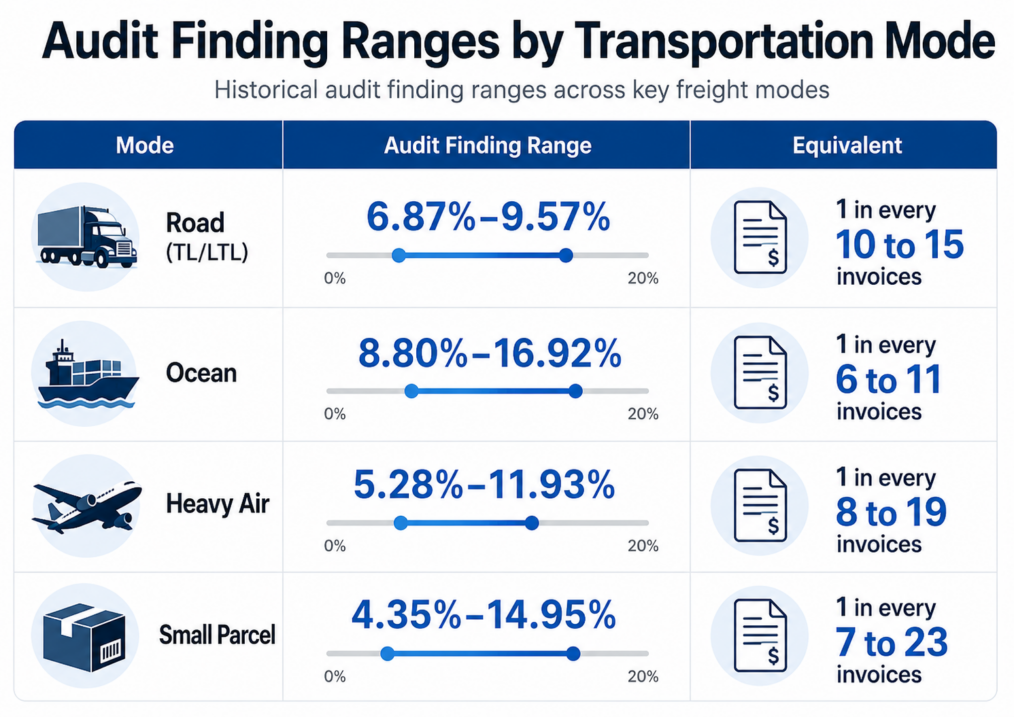
These findings help explain why freight audit and payment has historically been so important. They also show why the discipline is expanding. Each discrepancy is not only a potential recovery or prevention opportunity; it is also a data point that can reveal patterns by carrier, lane, mode, region, business unit, accessorial type, contract term, or approval process.
The New View: Protect Margin and Improve Confidence
In today’s transportation environment, costs can shift quickly. Fuel volatility, changing demand, capacity constraints, accessorial growth, global disruption, regulatory changes, and transportation provider variability can all create financial pressure.
Small invoice errors may not appear significant on their own. But across thousands or millions of shipments, small errors become real money. A misapplied surcharge, an incorrect rate table, a duplicate charge, or an unchallenged exception can quietly erode margin over time.
nVision Global’s financial control and governance metrics reinforce that point. The company’s 9.55% average audit finding rate means that approximately one in every 10 invoices contains at least one billing discrepancy. Across all transportation modes and global regions, the average financial adjustment per audit finding is $183.54, and in 2025, nVision identified more than $360 million in transportation financial adjustments.
This is where freight audit becomes a margin protection function.
By validating freight invoices before payment, companies can reduce leakage and improve control over transportation spend. By organizing invoice-level data into accurate reporting, they can better understand cost trends, provider performance, accessorial exposure, and budget variance. By connecting freight data to finance, procurement, and supply chain decisions, they can move from reacting to spend toward actively managing it.
The result is not just cleaner invoices. The result is greater confidence.
Finance can trust the transportation numbers used in reporting. Procurement can evaluate whether negotiated savings are actually being realized. Supply chain leaders can see where cost exceptions are occurring. Executives can make decisions based on validated data rather than disconnected estimates.
Freight Data Has Financial Data
Freight invoices are often treated as payment documents. But they are also data assets.
Each invoice can contain shipment details, origin and destination information, service levels, modes, weights, zones, rates, discounts, surcharges, accessorials, taxes, duties, provider information, payment terms, and exception details. When that information is captured, validated, standardized, and analyzed, it becomes a source of transportation financial intelligence.
But that intelligence depends on the quality of the data.
If invoice data is inaccurate, incomplete, or inconsistent, the reporting built on top of it will be unreliable. If data is not governed properly, different teams may use different numbers to answer the same financial questions. If upstream processes are not controlled, downstream reporting and analytics become harder to trust.
That is why freight audit and payment plays such an important role.
It sits at the intersection of transportation execution, financial accuracy, provider compliance, and business intelligence. It is one of the few areas where operational activity and financial truth can be reconciled at the transaction level.
Better Controls Create Better Decisions
A modern freight audit and payment program should help answer important business questions, including:
- Are we paying according to our contracted rates?
- Which transportation providers, lanes, modes, or regions are creating the most exceptions?
- Where are accessorial charges increasing
- Are negotiated savings being captured?
- Are certain locations or business units driving unexpected costs?
- Are payment processes aligned with internal financial controls?
- Do finance, procurement, and logistics have access to the same trusted transportation spend data?
These questions go beyond invoice processing. They support financial governance.
The stronger the freight audit process, the stronger the company’s ability to understand and manage transportation spend. Clean data leads to better reporting. Better reporting leads to better decisions.
Better decisions lead to improved financial outcomes.
That is the larger opportunity. Audit findings can identify more than overcharges; they can point to cost reduction opportunities, contract improvement opportunities, procurement opportunities, provider performance opportunities, process improvement opportunities, compliance and governance opportunities, customer service opportunities, and working capital opportunities.
Automation Helps, but Governance Matters
Technology has transformed freight audit and payment. Automation, OCR, EDI, APIs, business rules, machine learning, and analytics can all improve speed, scale, and accuracy.
But technology alone does not create control.
The value comes from how technology is applied. Freight audit requires clear rules, accurate rate data, provider compliance, exception workflows, documentation standards, reporting discipline, and experienced professionals who understand the realities of transportation billing.
AI and automation can help identify patterns, flag anomalies, process documents, and improve efficiency. But those tools must operate within a governed framework. Without strong controls, automation can simply move bad data faster.
That is why the future of freight audit is not automation alone. It is automation supported by governance, expertise, and financial discipline.
The operational metrics matter because they show how technology and governance work together. nVision Global reports:
- 99.3% nSure AI Data Capture Accuracy
- 94.4% Automated Audit Success Rate
- 93.4% Fully Automated Processing with no manual intervention required
- 98.7% Successful EDI Transmission Rate
- 99.1% System Availability YTD
- 93.8% First-Pass Processing Success
- 96.8% Invoice Documentation Compliance
These numbers are not just technology statistics. They support the broader financial control environment by improving data capture quality, processing consistency, documentation discipline, EDI reliability, and workflow confidence.
Freight Audit as a Strategic Business Function
As transportation networks become more complex, the expectations placed on freight audit and payment will continue to grow.
Companies need more than invoice processing. They need accurate financial data. They need visibility into cost drivers. They need controls that reduce leakage. They need confidence that transportation spend is being reviewed, validated, and managed properly.
That shift changes the role of freight audit.
It is no longer just a service that helps accounts payable process invoices. It is a strategic function that supports finance, logistics, procurement, and executive leadership. It helps turn transportation spend into trusted business intelligence.
For companies managing significant freight spend, this evolution is not optional. Transportation costs are too important to leave unmanaged, unvalidated, or disconnected from financial decision-making.
The Bottom Line
Freight audit and payment has become a financial control function because transportation spend has become too complex and too financially significant to manage reactively.
The companies that treat freight audit as a simple transactional process may continue to find and correct individual invoice errors. But the companies that treat it as a control function will gain something more valuable: cleaner data, stronger governance, better visibility, improved margin protection, opportunity identification, and greater confidence in transportation spend decisions.
In today’s environment, freight audit is not just about what was overcharged.
It is about what your transportation data can tell you, what your financial controls can prevent, and how confidently your business can act on the numbers behind your freight spend.
nVision Global helps companies move beyond traditional freight audit and payment by combining technology, transportation expertise, global operations, and business intelligence to create greater control over transportation spend. With accurate data, disciplined processes, and actionable insights, organizations can better protect margin, improve financial confidence, and make smarter decisions across their transportation network.
To learn how nVision Global can help strengthen your freight audit and payment process, contact our team today.
The post Freight Audit And Payment Has Become a Financial Control Function appeared first on nVision Global | Worldwide Supply Chain Solutions, Specializing in Global Freight Audit & Payment, Loss & Damage Claims, Supply Chain Services & Technology.
]]>The post How Transportation Data Helps Shippers Make Smarter Supply Chain Decisions appeared first on nVision Global | Worldwide Supply Chain Solutions, Specializing in Global Freight Audit & Payment, Loss & Damage Claims, Supply Chain Services & Technology.
]]>
Most companies have more transportation data than they realize.
Every shipment, invoice, accessorial charge, fuel surcharge, delivery exception, freight claim, provider interaction, purchase order, bill of lading, routing decision, and payment record creates information that can help explain how the supply chain is performing.
The challenge is that this data is often scattered across systems, departments, locations, providers, spreadsheets, reports, and email threads. As a result, many companies can see activity, but they cannot always turn that activity into useful intelligence.
That distinction matters.
Transportation data is only valuable when it helps companies make better decisions. For shippers, that means using freight data to understand costs, improve provider accountability, identify network issues, support procurement, strengthen financial reporting, and make more confident supply chain decisions.
In today’s environment, visibility alone is not enough. Shippers need transportation data they can trust, interpret, and act on.
Why Transportation Data Is Often Underused
Transportation data is often treated as a record of what has already happened.
A shipment moved. An invoice was received. A charge was paid. A delivery was late. A claim was filed. A provider was used. A cost was reported.
But when transportation data is only used after the fact, companies miss its larger strategic value.
The problem is rarely a lack of data. The problem is that the data may be incomplete, inconsistent, disconnected, or difficult to interpret. Shipment data may live in one system. Invoice data may live in another. Provider contracts may be stored elsewhere. Claims may be managed separately. Reporting may rely on manual spreadsheet work.
When that happens, companies may struggle to answer important questions, such as:
- Why did transportation costs increase?
- Which lanes are driving the most spend?
- Which transportation providers are performing best?
- Are contracted rates being applied correctly?
- Where are accessorial charges increasing?
- Which facilities are creating recurring exceptions?
- Are freight claims concentrated by provider, lane, or product type?
- Which shipments are moving outside routing guidelines?
- How accurate are freight accruals and forecasts?
- Where can the company reduce cost without hurting service?
These are not just logistics questions. They are supply chain, procurement, finance, and operational questions.
When transportation data is difficult to connect, teams may make decisions based on partial information. They may see total spend, but not the reason behind the spend. They may see service issues, but not the pattern behind them. They may see invoice exceptions, but not the root cause.
That is why transportation data needs to become more than information. It needs to become intelligence.
Freight Invoice Data Reveals More Than Cost
Freight invoice data is one of the most valuable sources of transportation intelligence because it shows what the company was actually charged.
That makes it different from planned shipment data, quoted costs, or estimated rates. Invoice data reflects real financial activity. When it is validated and analyzed correctly, it can reveal whether transportation costs are accurate, expected, and aligned with contract terms.
Freight invoice data can help answer questions such as:
- Were contracted rates applied correctly?
- Were fuel surcharges calculated properly?
- Were accessorial charges valid?
- Were duplicate charges submitted?
- Were taxes, duties, or currency conversions handled correctly?
- Did the shipment match the invoice?
- Was the correct transportation provider, mode, lane, and service level used?
- Was the invoice coded correctly for financial reporting?
This matters because freight invoice errors can affect more than accounts payable. They can influence margin, cash flow, accruals, budgeting, customer profitability, provider negotiations, and month-end reporting.
When freight audit data is accurate and accessible, it gives companies a clearer understanding of transportation spend. It also helps finance and logistics teams speak from the same set of numbers.
That is where invoice data becomes strategic. It does not just help companies pay bills. It helps them understand whether freight costs are correct, controlled, and explainable.
Shipment Data Helps Identify Network Patterns
Shipment data helps companies understand how freight is actually moving through the network.
At the shipment level, this may include origin, destination, mode, provider, service level, pickup date, delivery date, weight, dimensions, shipment type, purchase order, bill of lading, customer, facility, and delivery performance.
On its own, this information is useful. But when shipment data is analyzed over time, it can reveal broader network patterns.
For example, companies may discover:
- Certain lanes are consistently more expensive than expected
- Specific facilities create recurring delays or exceptions
- Some modes are being used when better options may be available
- Shipment consolidation opportunities are being missed
- Certain customers or regions are driving disproportionate cost
- Expedited freight is increasing because of planning issues
- Routing guide compliance is inconsistent
- Delivery performance varies significantly by provider or lane
These insights help shippers move from reactive problem-solving to proactive improvement.
Instead of looking at one late delivery or one expensive shipment, teams can identify recurring patterns and determine whether the issue is related to planning, provider performance, routing, facility behavior, order timing, mode selection, or documentation.
That is the difference between seeing a problem and understanding why the problem exists.
Provider Performance Data Supports Better Accountability
Transportation provider performance has a direct impact on cost, service, customer satisfaction, and operational stability.
But provider performance is difficult to manage without reliable data.
A transportation provider may appear to be performing well based on anecdotal feedback, but the data may tell a different story. Another provider may seem expensive at the rate level, but may deliver better service, fewer exceptions, fewer claims, and lower total cost over time.
That is why provider performance should be evaluated using a more complete view.
Useful provider performance metrics may include:
- On-time pickup
- On-time delivery
- Invoice accuracy
- Accessorial charge frequency
- Claims activity
- Dispute volume
- Tender acceptance
- Service consistency
- Lane-level performance
- Cost versus contract
- Exception frequency
- Responsiveness and resolution time
When this data is available, shippers can have more productive conversations with transportation providers. Instead of relying on general impressions, they can point to specific performance trends, billing issues, service gaps, and improvement opportunities.
Provider performance data also supports procurement. During sourcing events, companies can evaluate not just price, but total value. A lower rate may not be the best option if it comes with poor service, excessive exceptions, frequent billing errors, or higher claims exposure.
Better data helps companies hold transportation providers accountable while also identifying which relationships are creating the most value.
Transportation Data Helps Finance Understand Freight Spend
Transportation costs are a major operating expense for many companies, yet finance teams often do not have the level of detail needed to fully understand what is driving those costs.
They may see freight spend increasing, but not know whether the increase is caused by volume, rate changes, fuel, accessorial charges, mode shifts, provider mix, network changes, invoice errors, expedited shipments, or routing noncompliance.
That lack of clarity creates problems for budgeting, forecasting, accruals, margin analysis, and financial reporting.
Transportation data helps close that gap.
When freight data is accurate and connected, finance teams can better understand:
- Freight spend by lane, mode, region, business unit, and customer
- Actual cost versus expected cost
- Invoice exceptions and unresolved disputes
- Accrued freight cost versus paid freight cost
- Cost trends over time
- Fuel surcharge impact
- Provider-level cost changes
- Accessorial charge growth
- Transportation cost per unit, order, or shipment
- Budget variances and root causes
This gives finance teams more confidence in the numbers behind transportation spend.
It also helps logistics and finance work together more effectively. Logistics can explain what is happening in the network. Finance can understand how those changes affect cost, margin, and reporting.
That collaboration becomes especially important when companies are under pressure to protect profitability and improve cash control.
Claims Data Can Reveal Hidden Supply Chain Risk
Freight claims are often viewed as isolated events.
A shipment was damaged. Product was lost. Documentation was submitted. Recovery was pursued.
But claims data can reveal much more than individual loss or damage events. When analyzed properly, freight claims can expose hidden supply chain risk.
For example, claims data may show that damage is concentrated by:
- Transportation provider
- Lane
- Facility
- Product type
- Packaging method
- Mode
- Region
- Customer
- Handling process
- Time period
These patterns can help companies identify operational issues that may otherwise remain hidden.
If one provider is tied to repeated damage claims, that may require a performance review. If one facility is associated with recurring shortages or documentation gaps, that may point to process issues. If one product category generates frequent claims, packaging or handling requirements may need to be evaluated.
Claims data is not just about recovery. It is also about prevention.
When companies connect claims data with shipment, invoice, provider, and facility data, they can better understand where risk exists in the transportation network and what actions may help reduce future losses.
Better Data Supports Smarter Procurement Decisions
Procurement teams need more than rates to make strong transportation decisions.
They need to understand the full cost and performance picture.
A provider with an attractive rate may not be the best option if invoice accuracy is poor, service failures are frequent, claims activity is high, or accessorial charges regularly increase total cost. Likewise, a provider with a slightly higher rate may deliver stronger overall value through better reliability, fewer disputes, and more consistent performance.
Transportation data helps procurement evaluate:
- Historical spend
- Lane-level cost trends
- Provider performance
- Contract compliance
- Fuel surcharge impact
- Accessorial charge patterns
- Claims history
- Service reliability
- Mode optimization opportunities
- Routing guide effectiveness
This helps procurement move from rate negotiation to total transportation cost management.
The goal is not simply to select the lowest-cost provider. The goal is to choose transportation providers, modes, and contract terms that support the company’s cost, service, risk, and operational requirements.
When procurement decisions are supported by validated freight data, companies can negotiate more effectively and make decisions with greater confidence.
Transportation Data Turns Visibility Into Control
Many companies invest in supply chain visibility. They want to know where shipments are, when they will arrive, and whether exceptions are occurring.
That visibility is important.
But visibility alone does not create control.
A company can see that a shipment is late and still not understand why delays keep happening. It can see that freight spend is rising and still not know which charges are driving the increase. It can see invoice exceptions and still lack a process for resolving them consistently.
Control requires more than seeing activity. It requires connected data, business rules, workflows, accountability, and decision-making.
Transportation data supports control when it helps companies:
- Validate freight invoices before payment
- Identify billing discrepancies
- Track and resolve exceptions
- Monitor provider performance
- Enforce routing guide compliance
- Analyze cost trends
- Support better procurement decisions
- Improve claims recovery and prevention
- Provide better reporting to finance
- Make smarter mode and lane decisions
This is where transportation data becomes a strategic asset. It helps companies not only observe the supply chain but manage it more effectively.
How Shippers Can Get More Value From Transportation Data
To get more value from transportation data, companies need to focus on quality, connection, and usability.
Data should be accurate enough to trust, organized enough to analyze, and accessible enough to support decisions across teams.
A stronger transportation data strategy should include:
- Validated freight invoice data
- Clean shipment records
- Accurate provider and contract information
- Clear exception workflows
- Consistent reporting structures
- Lane, mode, region, and provider-level analysis
- Integration between logistics and finance data
- Historical trend visibility
- Actionable dashboards and reporting
- Human expertise to interpret results
Technology is essential, but technology alone is not enough. Companies also need people who understand transportation operations, freight audit, provider behavior, contract terms, financial reporting, and exception management.
The strongest approach combines automation, analytics, workflow discipline, and experienced support.
That combination helps companies turn transportation data into business intelligence.
Why This Matters for Shippers
Transportation decisions affect cost, service, margin, working capital, customer experience, and supply chain resilience.
When decisions are made with incomplete or unreliable data, companies may overpay, miss savings opportunities, tolerate poor provider performance, misread cost trends, or struggle to explain transportation spend to leadership.
When decisions are supported by trusted transportation data, shippers can operate with greater confidence.
They can see where costs are rising, where service is breaking down, where providers are performing well, where contracts are not being followed, where claims are occurring, and where better decisions can improve the business.
In today’s supply chain environment, transportation data should not be treated as a byproduct of freight activity.
It should be treated as a decision-making asset.
How nVision Global Helps
nVision Global helps shippers turn transportation data into smarter supply chain decisions by connecting freight audit and payment, transportation management, claims management, analytics, reporting, and experienced operational support.
By validating freight invoices, managing exceptions, analyzing transportation spend, monitoring provider performance, supporting claims recovery, and delivering actionable freight intelligence, nVision Global helps companies gain a clearer view of their transportation network and the financial impact behind it.
For logistics, supply chain, procurement, and finance teams, trusted freight data can help improve cost control, strengthen accountability, support better planning, and create more confidence in the decisions that shape the supply chain.
Transportation data is only powerful when it can be trusted.
nVision Global helps shippers turn that data into control.
The post How Transportation Data Helps Shippers Make Smarter Supply Chain Decisions appeared first on nVision Global | Worldwide Supply Chain Solutions, Specializing in Global Freight Audit & Payment, Loss & Damage Claims, Supply Chain Services & Technology.
]]>The post 5 Signs It May Be Time to Shift Freight from Truckload to Intermodal appeared first on nVision Global | Worldwide Supply Chain Solutions, Specializing in Global Freight Audit & Payment, Loss & Damage Claims, Supply Chain Services & Technology.
]]>
Truckload shipping plays an essential role in many transportation networks. It offers flexibility, direct service, broad availability, and the ability to move freight across a wide range of lanes, shipment types, and delivery requirements.
But a truckload is not always the most cost-effective or strategic option.
For shippers managing large or complex transportation networks, there are times when shifting certain freight from truckload to intermodal can create meaningful opportunities for cost control, capacity flexibility, and network optimization. The key is knowing when intermodal makes sense and when it does not.
Intermodal is not a universal replacement for truckload. It works best when the freight profile, lane structure, service expectations, volume patterns, and cost objectives align. That is why the decision should be driven by data, not assumptions.
Here are five signs it may be time to evaluate whether some of your truckload freight should move to intermodal.
1. Long-Haul Truckload Costs Are Putting Pressure on Your Budget
One of the clearest signs that intermodal may deserve a closer look is sustained cost pressure on longer-haul truckload lanes.
When truckload rates increase, fuel costs fluctuate, accessorial charges grow, or capacity becomes more difficult to secure, transportation budgets can feel the impact quickly. This is especially true for shippers moving recurring freight over longer distances.
Intermodal can sometimes offer a more cost-effective alternative for lanes where rail infrastructure, drayage availability, shipment timing, and service requirements support the move.
The important point is not simply that intermodal may cost less. The important point is that shippers need a disciplined way to compare total cost.
That means looking beyond the base transportation rate and evaluating:
- Linehaul costs
- Fuel surcharges
- Drayage costs
- Accessorial charges
- Detention or storage exposure
- Transit time requirements
- Service reliability
- Claims history
- Facility readiness
- Provider performance
A shipment that appears less expensive at first may not create real savings if it introduces delays, added handling issues, documentation gaps, or service failures. Likewise, a lane that has always moved by truckload may be a strong candidate for intermodal if the total transportation cost profile supports it.
Shippers should not evaluate truckload and intermodal only by rate. They should evaluate them by total network impact.
2. Your Freight Has Some Transit Time Flexibility
Intermodal is often better suited for freight that does not require the same speed or delivery precision as certain truckload moves.
That does not mean intermodal is unreliable. It means the service model is different. Intermodal typically involves multiple transportation stages, including origin drayage, rail movement, destination drayage, and coordination between multiple parties. Because of this, transit times and planning windows may differ from direct truckload service.
If your freight has some flexibility in delivery timing, intermodal may become a stronger option.
Good candidates may include:
- Planned replenishment freight
- Non-expedited shipments
- Predictable recurring lanes
- Inventory that can be planned in advance
- Freight with stable delivery windows
- Moves where speed is less important than cost control
The more predictable the shipment, the easier it becomes to evaluate intermodal as part of the routing strategy.
This is where better transportation data matters. Shippers need to understand which shipments truly require truckload speed and which shipments are moving by truckload simply because that has always been the default.
Many companies discover that not all “urgent” freight is actually urgent. Some freight is simply being planned too late, routed inconsistently, or managed through disconnected processes.
When teams have better visibility into shipment patterns, lead times, order behavior, and delivery requirements, they can make smarter decisions about which freight should stay on truckload and which freight may be eligible for intermodal.
3. You Have Consistent Volume on Repeatable Lanes
Intermodal becomes easier to evaluate when there is consistent freight volume moving across repeatable lanes.
One-time shipments, irregular routes, and highly variable freight profiles can be more difficult to shift. But recurring truckload moves between consistent origins and destinations may create better opportunities for analysis.
If your company regularly ships freight along the same corridors, those lanes may be worth reviewing.
The right questions include:
- Which truckload lanes have steady volume?
- Which lanes have predictable pickup and delivery patterns?
- Which lanes experience recurring cost increases?
- Which lanes have rail options available?
- Which lanes have reliable origin and destination drayage coverage?
- Which lanes have freight that can tolerate intermodal transit windows?
Freight data can help identify where these opportunities exist. Without lane-level analysis, companies may miss patterns hidden inside thousands of shipments and invoices.
For example, a logistics team may know truckload costs are increasing overall, but may not know which lanes are driving the increase. A finance team may see transportation spend rising, but may not know whether the issue is rate, fuel, volume, accessorials, service failures, or inefficient mode selection.
When freight audit, shipment, invoice, and provider data are connected, shippers can begin to see where specific lane-level decisions may improve cost control.
That is when intermodal becomes less of a guess and more of a data-supported option.
4. Truckload Capacity or Service Is Becoming Inconsistent
Another sign it may be time to evaluate intermodal is inconsistent truckload service or capacity on certain lanes.
When shippers experience repeated tender rejections, limited availability, late pickups, missed appointments, rising spot market exposure, or service disruptions, it may be worth asking whether the current mode strategy is still working.
Truckload will remain the right answer for many shipments. But when specific lanes repeatedly create operational challenges, intermodal may offer another way to build flexibility into the network.
This does not mean shifting freight reactively every time the market changes. It means using data to understand whether recurring capacity or service issues are part of a larger pattern.
For example:
- Are certain lanes consistently difficult to cover?
- Are costs rising because contracted options are not being used?
- Are teams relying too heavily on spot moves?
- Are certain transportation providers missing service expectations?
- Are facilities experiencing repeated delays or accessorial charges?
- Are routing guide exceptions becoming more common?
These questions matter because mode decisions are closely tied to routing discipline, provider performance, procurement strategy, and operational planning.
If truckload service problems are isolated, they may need to be addressed through provider management or routing guide compliance. If they are recurring and lane-specific, intermodal may deserve consideration as part of a broader transportation strategy.
5. Your Freight Data Shows a Bigger Cost-Control Opportunity
Perhaps the strongest sign that it is time to evaluate a truckload-to-intermodal shift is when the data points to a larger cost-control opportunity.
Transportation decisions should not be based only on habit, historical preference, or individual shipment needs. They should be informed by accurate freight data.
That includes data from:
- Freight invoices
- Shipment history
- Contracted rates
- Fuel surcharge tables
- Accessorial charges
- Routing guide compliance
- Provider performance
- Claims activity
- Mode usage
- Lane-level cost trends
- Delivery performance
- Exception history
When this data is validated and organized, shippers can see where transportation spend is being driven by mode selection, rate changes, inefficient routing, poor planning, or recurring exceptions.
This is where intermodal analysis can become especially useful.
A company may find that certain lanes are consistently moving by truckload even though they have predictable volume, flexible transit requirements, and recurring cost pressure. Another company may find that intermodal is not the right fit for a specific lane because service risk, added handling, or delivery requirements outweigh potential savings.
Both outcomes are valuable.
The goal is not to force freight into intermodal. The goal is to make better transportation decisions based on the true cost and performance of the network.
You can also read this blog: The Truckload Market Has Shifted: Why Visibility Alone Isn’t Enough in 2026
Intermodal Should Be Part of a Larger Transportation Strategy
Moving freight from truckload to intermodal is not simply a rate-shopping exercise. It is a network decision.
A successful mode shift requires coordination across logistics, procurement, finance, operations, and sometimes customer service. It also requires reliable data, clear expectations, provider accountability, and a realistic understanding of service requirements.
Before shifting freight, shippers should consider:
- Whether the freight profile is suitable for intermodal
- Whether the lane has strong intermodal options
- Whether delivery windows can support the change
- Whether facilities can manage pickup and delivery timing
- Whether providers can meet service expectations
- Whether savings remain after all costs are considered
- Whether the shift supports broader business goals
This is why a data-driven approach is so important. Without accurate freight data, companies may either miss opportunities or make changes that create new operational problems.
The best transportation strategies are not built around one mode. They are built around selecting the right mode for the right freight at the right time.
Why This Matters for Shippers
Transportation costs are too important to manage reactively.
For many companies, truckload is used because it is familiar, available, and operationally straightforward. But as transportation networks become more complex and cost pressures continue, shippers need to regularly evaluate whether their mode strategy still supports their financial and service goals.
Intermodal may not be the right answer for every shipment. But for the right lanes, with the right freight profile and planning discipline, it can be an important part of a broader transportation cost-control strategy.
The key is having the data to know where it makes sense.
How nVision Global Helps
nVision Global helps shippers gain better visibility and control over transportation spend by connecting freight audit, payment, transportation management, analytics, reporting, and provider performance data.
By helping companies validate freight costs, analyze lane-level trends, identify recurring exceptions, monitor provider performance, and turn transportation data into actionable intelligence, nVision Global supports more informed decisions across the freight network.
For companies evaluating truckload, intermodal, or other mode optimization opportunities, the right data can make the difference between a guess and a strategy.
Shifting freight from truckload to intermodal should not start with assumptions.
It should start with trusted transportation data.
The post 5 Signs It May Be Time to Shift Freight from Truckload to Intermodal appeared first on nVision Global | Worldwide Supply Chain Solutions, Specializing in Global Freight Audit & Payment, Loss & Damage Claims, Supply Chain Services & Technology.
]]>The post When Customs Rules Change Overnight, Your Transportation Network Has to Be Ready appeared first on nVision Global | Worldwide Supply Chain Solutions, Specializing in Global Freight Audit & Payment, Loss & Damage Claims, Supply Chain Services & Technology.
]]>
The recent disruption surrounding DHL Globalmail and UK-to-EU parcel shipments is a clear reminder that transportation networks are no longer disrupted only by weather events, labor constraints, fuel volatility, or capacity shortages. Regulatory change can now create the same level of operational impact, and in some cases, it can happen with very little notice.
Beginning July 1, 2026, the European Union is removing the €150 customs duty exemption on low-value imports. As part of the change, most low-value B2C shipments entering the EU from outside the bloc will be subject to a flat €3 customs duty per HS code line item. That may sound manageable on the surface, but the real issue is not just the amount of the duty. The real issue is the operational process required to support it.
For many shippers, this change turns a previously simple cross-border parcel movement into a more complex transaction that requires accurate product classification, proper customs documentation, upfront duty calculation, sender-paid duty handling, and transportation provider systems capable of supporting Delivered Duty Paid requirements.
Reports indicate that DHL Globalmail temporarily suspended UK-to-EU shipments containing goods because their system was not yet equipped to support the required declare-and-remit process. DHL Express will continue to operate, but the impact on Globalmail users is an important warning for any company that depends on a single transportation provider, service level, route, or customs process to move product across borders.
This is not just a parcel issue. It is a transportation network readiness issue.
The Cost of Being Unprepared
When a transportation provider lane becomes unavailable, companies are forced to react quickly. That reaction often means moving volume to a higher-cost service, manually searching for alternative transportation providers, delaying customer shipments, rerouting inventory, or absorbing unexpected transportation and customs-related costs.
For companies with thin margins, high order volumes, or complex international shipping profiles, even a short disruption can create a ripple effect across the business. Orders can miss delivery commitments. Customer service teams can be flooded with questions. Finance teams can lose visibility into the true landed cost. Logistics teams can be forced into manual workarounds. Procurement teams may have to negotiate under pressure instead of with leverage.
The duty itself may be visible. The larger risk is what happens when the transportation network behind it is not prepared.
Why Transportation Management Matters More Than Ever
This is where a strong transportation management strategy becomes critical.
nVision Global’s IMPACT TMS helps companies gain control of their transportation operations by bringing planning, rating, routing, tendering, execution, visibility, freight audit and payment, and analytics together in one connected ecosystem.
When regulatory changes impact a shipping lane, companies need to know more than which transportation provider is affected. They need to understand what volume is at risk, what orders are exposed, what alternate services are available, what those alternatives will cost, and how those decisions will impact delivery performance, landed cost, and customer expectations.
IMPACT TMS gives shippers the ability to manage those decisions with better data and better control.
Building Resilience Into the Network
A disruption like the DHL Globalmail situation highlights several important questions every shipper should be asking:
- Do we have visibility into which lanes, transportation providers, and service levels are most exposed to customs or regulatory change?
- Can we quickly identify alternative transportation providers if a service is suspended?
- Do we understand the landed cost impact of moving from one service level to another?
- Are our routing guides flexible enough to support fast changes without losing control?
- Can we audit new charges, customs-related fees, and accessorials before payment?
Do we have the reporting needed to see which regions, products, suppliers, or customers are being affected?
These are not questions companies want to answer after a disruption has already occurred. These are questions that should be answered before the next rule change, service restriction, border delay, or market disruption creates an operational challenge.
More Than Visibility
Visibility is important, but visibility by itself is not enough. Knowing that a shipment is delayed does not solve the problem. Knowing that a transportation provider service is suspended does not automatically create a recovery plan. Knowing that costs increased does not explain whether those costs were valid, avoidable, or the result of poor routing decisions.
Companies need transportation technology and logistics expertise that help them act.
With IMPACT TMS, shippers can better manage routing guides, compare transportation options, automate tendering, use spot quote and auction tools when needed, track shipments in real time, and connect transportation activity back to freight audit and payment. That closed-loop approach helps companies move from reacting to disruptions to actively managing them.
Freight Audit and Payment Becomes a Control Function
Regulatory changes also create financial complexity. New duties, customs-related charges, transportation provider fees, documentation charges, and service changes can quickly find their way into freight invoices.
Without a strong freight audit and payment process, companies may pay charges they do not understand, cannot validate, or cannot properly allocate. That creates problems for finance, logistics, procurement, and customer profitability analysis.
nVision Global’s freight audit and payment solutions help companies validate transportation charges, identify discrepancies, manage exceptions, and create cleaner freight spend data. When combined with IMPACT TMS and business analytics, that data becomes more than an invoice record. It becomes a decision-making tool.
Preparing for the Next Impact
The EU customs change is not an isolated event. Around the world, governments are rethinking de minimis thresholds, customs data requirements, duty collection models, parcel oversight, and import compliance. At the same time, transportation providers are adapting their networks, service offerings, pricing structures, and technology to keep up.
That means shippers need to prepare for a transportation environment where change is continuous.
The companies that are best prepared will be those that have the systems, data, processes, and partners in place to adapt quickly. They will know where their exposure is. They will understand their transportation provider options. They will have better visibility into cost and performance. They will be able to validate charges and manage exceptions. Most importantly, they will not be forced to make critical logistics decisions with incomplete information.
nVision Global Helps Companies Get Ready
At nVision Global, we help companies manage the complexity of global transportation through integrated technology, freight audit and payment, transportation management, claims management, procurement support, and business intelligence.
IMPACT TMS gives logistics teams the tools to plan, execute, monitor, and optimize shipments across their transportation network. Our freight audit and payment solutions help finance and logistics teams validate costs and control freight spend. Our analytics help companies identify trends, measure transportation provider performance, and understand where risk is building inside the network.
When transportation rules change, companies should not have to scramble to understand the impact.
They should already have the visibility, controls, and data needed to respond.
The DHL Globalmail disruption is a reminder that transportation networks are only as strong as the systems and processes supporting them. For companies shipping globally, now is the time to evaluate whether their transportation operation is ready for the next regulatory, transportation provider, or market disruption.
Because the next impact to your transportation network may not come with much warning.
The post When Customs Rules Change Overnight, Your Transportation Network Has to Be Ready appeared first on nVision Global | Worldwide Supply Chain Solutions, Specializing in Global Freight Audit & Payment, Loss & Damage Claims, Supply Chain Services & Technology.
]]>The post 7 Fuel Cost Mitigation Strategies That Help Shippers Control Transportation Spend appeared first on nVision Global | Worldwide Supply Chain Solutions, Specializing in Global Freight Audit & Payment, Loss & Damage Claims, Supply Chain Services & Technology.
]]>
Fuel costs have always been among the most unpredictable components of transportation spend.
For shippers, the challenge is not only that fuel prices rise and fall. The bigger issue is that fuel-related costs often flow through freight invoices, contracts, surcharge tables, provider agreements, routing decisions, accessorial charges, and mode choices in ways that are difficult to monitor consistently.
When fuel costs are not clearly understood, they can quietly distort transportation budgets, margin analysis, provider comparisons, and financial forecasts.
That is why fuel cost mitigation is not simply a procurement issue. It is a transportation spend control issue.
Shippers need the ability to see how fuel costs are applied, whether fuel surcharges align with contract terms, which lanes are most exposed, and how transportation decisions affect total cost. Without that visibility, companies may struggle to understand whether rising freight costs are caused by market conditions, surcharge errors, inefficient routing, poor mode selection, or lack of compliance with negotiated agreements.
Here are seven fuel cost mitigation strategies that can help shippers gain better control over transportation spend.
1. Audit Fuel Surcharge Calculations
Fuel surcharges can represent a significant portion of total freight cost, especially across high-volume transportation networks.
But fuel surcharge calculations are not always simple. They may vary by transportation provider, mode, region, lane, contract, index, mileage calculation, shipment date, or service type. Some agreements may use weekly fuel tables. Others may use different base rates, trigger points, mileage bands, or calculation methods.
That complexity creates room for error.
A fuel surcharge that is only slightly incorrect on one invoice may not seem significant. But when the same error repeats across hundreds or thousands of shipments, the financial impact can become meaningful.
Shippers should regularly validate fuel surcharge charges against contract terms and agreed-upon calculation methods. This includes reviewing:
- The correct fuel index or table
- The correct shipment date or billing date
- The correct mileage calculation
- The correct base rate or trigger point
- The correct surcharge percentage or amount
- The correct application by mode, lane, or service type
- Any minimums, caps, or special terms
Fuel surcharge auditing helps ensure companies are not paying more than agreed. It also creates a clearer record of how fuel-related charges are affecting transportation spend.
2. Compare Fuel Terms Across Transportation Providers
Not all fuel surcharge programs are created equal.
Two transportation providers may offer similar base rates but very different fuel surcharge structures. One may appear less expensive during procurement, but become more costly when fuel surcharge terms, accessorials, mileage rules, or service requirements are factored into the total landed transportation cost.
That is why shippers need to compare fuel terms as part of the full cost picture.
A provider-by-provider comparison should evaluate:
- Base transportation rates
- Fuel surcharge formulas
- Index references
- Surcharge update frequency
- Mileage methodology
- Accessorial exposure
- Contract exceptions
- Lane-level impact
- Historical invoice behavior
- Total cost after fuel is applied
This kind of analysis helps procurement and logistics teams avoid decisions based on incomplete rate comparisons.
A lower linehaul rate does not always mean a lower total cost. If fuel surcharge terms are less favorable, the apparent savings may disappear once invoices are paid.
By comparing providers on total freight cost, not just base rate, shippers can make stronger sourcing and routing decisions.
3. Monitor Fuel Impact by Lane, Mode, and Region
Fuel costs do not affect every part of a transportation network equally.
Some lanes may be more exposed because of distance, geography, provider structure, service requirements, or recurring use of higher-cost modes. Other areas of the network may experience fuel-related cost pressure because freight is moving inefficiently, shipments are being expedited too often, or routing guide compliance is weak.
Averages can hide these differences.
That is why shippers should monitor fuel impact at a more detailed level, including:
- Lane
- Mode
- Region
- Facility
- Customer
- Business unit
- Transportation provider
- Shipment type
- Service level
This level of visibility helps companies understand where fuel-related costs are concentrated and whether those costs are expected, justified, or avoidable.
For example, a company may discover that fuel costs are increasing primarily on a handful of recurring lanes. Another may find that expedited shipments are creating disproportionate fuel-related exposure. Another may see that certain regions or facilities are consistently producing higher surcharge costs than expected.
The value comes from being able to separate broad market pressure from specific operational issues.
Without that detail, fuel cost mitigation becomes guesswork.
4. Strengthen Routing Guide Compliance
Even well-negotiated fuel terms cannot protect transportation spend if teams are not following the routing guide.
When shipments move outside approved provider, mode, or lane instructions, companies may lose the benefit of negotiated rates and fuel surcharge terms. This can lead to higher costs, more exceptions, greater spot market exposure, and less predictable transportation spend.
Routing guide compliance is especially important when fuel costs are volatile because off-guide shipments can magnify cost exposure quickly.
Shippers should evaluate whether freight is moving according to approved routing instructions and whether exceptions are being properly documented and approved.
Important questions include:
- Are teams using approved transportation providers?
- Are shipments moving by the correct mode?
- Are routing guide exceptions increasing?
- Are spot moves being used too frequently?
- Are facilities following established processes?
- Are approvals required before higher-cost options are used?
- Are exceptions visible to logistics and finance leadership?
When routing guide compliance is weak, fuel cost mitigation becomes much harder. The company may have negotiated strong terms, but still fails to realize the benefit because execution is inconsistent.
A disciplined routing process helps ensure fuel-related cost control does not stop at procurement. It carries through to daily transportation execution.
5. Use Freight Audit Data to Identify Recurring Cost Issues
Freight audit data is one of the most valuable sources of insight for fuel cost mitigation.
Freight invoices show what the company was actually charged. When that invoice data is validated, normalized, and analyzed, it can reveal patterns that are difficult to see through operational systems alone.
This may include:
- Repeated fuel surcharge discrepancies
- Provider-specific billing issues
- Lane-level cost increases
- Accessorial charges tied to inefficient scheduling
- Duplicate or incorrect charges
- Contract terms that are not being applied correctly
- Mode decisions that increase the total cost
- Facilities with recurring exception patterns
These insights matter because fuel-related cost issues are often connected to broader transportation processes.
For example, a fuel surcharge discrepancy may reveal a contract setup issue. A rise in fuel-related cost on a specific lane may indicate a need to revisit provider selection or mode strategy. A pattern of expensive exceptions may point to planning problems, late order releases, or weak routing control.
Freight audit should not be viewed only as a payment function. It should also serve as a source of transportation intelligence.
When companies use freight audit data effectively, they gain a clearer understanding of where fuel costs are coming from and what actions may help reduce unnecessary exposure.
6. Evaluate Mode Optimization Opportunities
Fuel cost mitigation is not only about auditing surcharges. It is also about making smarter transportation decisions.
Mode selection can have a significant effect on fuel-related cost exposure. In some cases, freight may be moving by a higher-cost mode because of habit, limited visibility, late planning, or lack of coordination across teams.
Shippers should regularly evaluate whether freight is moving by the most appropriate mode based on cost, service, timing, and operational requirements.
This may include reviewing opportunities to:
- Shift certain long-haul freight from truckload to intermodal
- Consolidate less-than-truckload shipments where appropriate
- Reduce unnecessary expedited shipments
- Improve shipment planning windows
- Use pool distribution or consolidation strategies
- Reassess parcel versus LTL decisions
- Evaluate regional provider options
- Reduce empty miles or inefficient routing patterns
The goal is not to force every shipment into the lowest-cost mode. The goal is to choose the right mode for the right freight.
Mode optimization requires reliable data. Shippers need to understand shipment history, cost trends, service performance, claims activity, transit requirements, and provider options before making changes.
When done properly, mode optimization can help reduce unnecessary fuel-related cost exposure while still protecting service requirements.
7. Turn Fuel Data Into Budgeting and Forecasting Intelligence
Fuel cost volatility affects more than transportation execution. It also affects budgeting, forecasting, accruals, financial reporting, and margin planning.
When fuel-related charges are buried inside freight invoices or reported only at a high level, finance teams may struggle to understand how transportation costs are changing and why. That makes it harder to forecast spend, explain budget variances, or model the financial impact of market changes.
Shippers can improve financial control by turning fuel-related transportation data into usable reporting.
This may include:
- Fuel surcharge trends over time
- Fuel impact by lane, mode, region, and provider
- Contracted versus actual fuel charges
- Fuel-related exceptions
- Budget variance analysis
- Cost-per-shipment trends
- Mode-level cost comparison
- Forecasting inputs for finance teams
This kind of intelligence helps companies move from reactive cost explanation to proactive cost management.
Instead of simply asking why freight spend increased after invoices have already been paid, teams can see where fuel-related exposure is building and make more informed decisions earlier.
That connection between transportation data and financial planning is becoming increasingly important. Freight costs are no longer just an operational expense. They are a margin, cash, and control issue.
Why Fuel Cost Mitigation Requires Better Data
Fuel cost mitigation is difficult when transportation data is disconnected.
If contract terms are in one system, shipment data is in another, invoice details are in another, and exception communication is handled through email, it becomes difficult to know whether fuel-related charges are accurate or manageable.
Shippers need trusted data that connects transportation activity with invoice validation, provider agreements, routing decisions, and financial reporting.
Without that connection, companies may know that fuel costs are increasing but not know:
- Which lanes are driving the increase
- Which providers are contributing most to the change
- Whether surcharges were calculated correctly
- Whether routing compliance is part of the problem
- Whether mode decisions are increasing exposure
- Whether invoice errors are being repeated
- Whether cost increases are market-driven or process-driven
Fuel cost mitigation starts with visibility, but it requires control.
That means validating charges, identifying exceptions, monitoring trends, enforcing routing discipline, and using freight data to support better decisions.
How nVision Global Helps
nVision Global helps companies gain better control over transportation spend by combining freight audit and payment, transportation management, analytics, reporting, and experienced operational support.
Through validated freight invoice data, exception management, provider performance insight, and transportation spend analytics, nVision Global helps shippers better understand what they are being charged, why they are being charged, where discrepancies exist, and how freight data can support smarter cost-control decisions.
For companies facing fuel cost volatility, the ability to audit charges, monitor trends, compare providers, and connect transportation data to financial decision-making can make a measurable difference.
Fuel prices may be unpredictable.
Your freight cost control process should not be.
The post 7 Fuel Cost Mitigation Strategies That Help Shippers Control Transportation Spend appeared first on nVision Global | Worldwide Supply Chain Solutions, Specializing in Global Freight Audit & Payment, Loss & Damage Claims, Supply Chain Services & Technology.
]]>The post What Finance Leaders Miss in Transportation Provider Contracts appeared first on nVision Global | Worldwide Supply Chain Solutions, Specializing in Global Freight Audit & Payment, Loss & Damage Claims, Supply Chain Services & Technology.
]]>
Transportation provider contracts are often evaluated through the lens of rates. Procurement teams negotiate discounts, logistics teams assess service capabilities, and finance leaders review projected savings. Yet many of the financial consequences embedded within transportation provider contracts have little to do with the transportation rate itself.
Some of the largest sources of cost variance originate from provisions that receive limited scrutiny during contract reviews. Accessorial structures, fuel surcharge mechanisms, audit rights, dispute windows, payment terms, and service-level commitments often have a greater long-term impact on transportation spend than the negotiated line-haul rate.
Understanding where these costs emerge can help finance leaders evaluate transportation provider contracts as financial instruments rather than operational agreements.

Why the lowest rate doesn’t always produce the lowest cost
Transportation providers frequently compete on rate discounts because they are easy to compare. A contract showing a larger discount off published tariffs may appear attractive during negotiations. However, transportation invoices rarely consist solely of transportation rates.
Fuel surcharges, detention charges, reclassification fees, residential delivery fees, and other accessorials often represent a substantial portion of total transportation spend. A contract with a slightly higher transportation rate but tighter controls around accessorial application may ultimately generate lower overall costs. This is one reason freight audit data frequently tells a different story than contract negotiations.
How fuel surcharge language can change cost outcomes
Fuel surcharge provisions often receive less attention than transportation rates. The formulas may appear straightforward, but the financial impact can be significant. Some agreements rely on publicly indexed calculations, while others use proprietary methodologies that create unexpected cost fluctuations during periods of fuel volatility.
Finance teams should evaluate how fuel surcharge formulas perform across a range of market conditions rather than focusing solely on current rates.
How audit rights determine whether costs can be recovered
One of the most overlooked provisions in transportation provider contracts involves audit and dispute rights. Many agreements establish strict timelines for identifying and disputing billing discrepancies. Once those windows expire, opportunities for recovery may disappear regardless of whether overcharges occurred.
Organizations processing thousands of transportation invoices each month need audit processes capable of identifying discrepancies before contractual dispute periods close. Otherwise, recoverable costs become permanent expenses.
How service commitments create financial consequences
Pricing is only one component of transportation performance. Delivery commitments, claims resolution procedures, appointment scheduling requirements, and exception management processes all influence transportation-related costs. Missed service commitments can trigger expedited shipments, inventory shortages, production disruptions, and customer service expenses.
Many of these costs appear outside transportation budgets, making them difficult to associate with the contract provisions that contributed to them.
How payment terms influence working capital
Payment terms affect more than accounts payable schedules. They directly influence working capital performance. Extending payment terms from 30 days to 60 or 90 days can improve liquidity, but those benefits depend on disciplined invoice validation, approval workflows, and payment administration. Poor execution can create provider disputes, penalties, and operational disruptions that offset the intended gains.
Organizations such as nVision Global can help align freight audit, payment administration, and transportation data management to support both operational requirements and financial objectives.
Why contract governance matters more than annual negotiations
Many organizations devote significant resources to negotiating transportation provider contracts and relatively little effort to monitoring performance after implementation. Transportation spend behavior changes continuously. New accessorial patterns emerge, service requirements evolve, and market conditions shift. Without ongoing visibility into invoice activity and contract compliance, organizations cannot accurately measure whether negotiated savings are being realized.
The most effective contracts are not necessarily the ones with the lowest rates. They are the agreements that create measurable, enforceable, and transparent cost structures throughout the relationship.

Why you should look beyond the rate sheet
Transportation provider contracts influence accessorial exposure, working capital performance, dispute recovery opportunities, and operational costs that extend beyond transportation budgets. Finance leaders who focus primarily on negotiated discounts often overlook the provisions that shape long-term financial performance.
As transportation spend grows more complex, transportation provider contracts deserve the same level of financial scrutiny applied to other major categories of corporate spending.
The post What Finance Leaders Miss in Transportation Provider Contracts appeared first on nVision Global | Worldwide Supply Chain Solutions, Specializing in Global Freight Audit & Payment, Loss & Damage Claims, Supply Chain Services & Technology.
]]>