The post Why Most Companies Overpay Without a Proper Parcel Freight Audit Process appeared first on nVision Global | Worldwide Supply Chain Solutions, Specializing in Global Freight Audit & Payment, Loss & Damage Claims, Supply Chain Services & Technology.
]]>
Parcel shipping looks simple from the outside.
A package is shipped. A carrier delivers it. An invoice is paid.
But for companies managing high parcel volumes, the reality is far more complex. Every shipment may include variables tied to weight, dimensions, zones, fuel, residential delivery, delivery area surcharges, address corrections, additional handling, peak demand charges, negotiated discounts, minimum charges, and service-level commitments.
That complexity creates a problem.
Without a proper parcel freight audit process, many companies overpay without realizing it.
The overpayment may not come from one dramatic billing mistake. More often, it comes from hundreds or thousands of small errors, exceptions, missed credits, contract mismatches, and surcharge discrepancies that quietly accumulate over time.
In a parcel environment where carriers continue to adjust rates, fees, and surcharge structures, invoice accuracy is no longer something companies can afford to assume. FedEx updated its 2026 rate-change page in May 2026, including fuel surcharge adjustments and 2026 package rate information, while UPS implemented a 5.9% average increase for ground, air, and international services beginning December 22, 2025, along with increases to several surcharges.
For enterprise shippers, the question is not whether parcel costs are rising.
The better question is: how much of that cost is valid?
Parcel Invoices Are More Complicated Than They Appear
Parcel invoices are not always easy to validate manually.
A single invoice can include thousands of shipment-level charges. Each shipment may have multiple cost components, including transportation charges, fuel surcharges, dimensional weight calculations, accessorial fees, address-related charges, delivery area adjustments, and contractual discounts.
The more shipments a company has, the harder it becomes to know whether each charge is correct.
That is where overpayment begins.
A company may assume that carrier invoice accuracy is automatic because the shipment data comes directly from the carrier. But carrier invoices still need to be checked against contract terms, shipment details, service commitments, and billing rules.
A proper parcel invoice auditing process reviews whether the carrier billed the correct amount based on the terms the shipper negotiated.
Without that process, incorrect charges may simply become part of the cost of doing business.
Small Parcel Billing Errors Can Become Big Cost Leaks
Parcel billing errors are often small at the shipment level.
That is what makes them easy to miss.
A few dollars for an incorrect surcharge. A misapplied residential delivery fee. A dimensional weight calculation that does not match the package profile. A missed discount. A duplicate charge. An address correction fee that should not apply.
Individually, these charges may not seem worth investigating.
At enterprise volume, they can become significant.
This is especially true for companies shipping across multiple facilities, business units, sales channels, customer types, and service levels. When parcel activity is spread across a large organization, billing errors can hide in the details.
A parcel freight audit helps identify those errors before payment or flags them for recovery when credits are owed.
That matters because shipping cost recovery is not just about finding mistakes. It is about protecting margin.
Contract Leakage Is One of the Biggest Hidden Problems
Many companies negotiate parcel contracts carefully.
They work to secure discounts, define surcharge terms, establish minimums, and improve pricing based on their shipping profile. But after the contract is signed, the real challenge begins.
Are those terms actually being applied?
Contract leakage happens when the negotiated agreement does not fully translate into the invoice. A carrier may apply the wrong rate, miss a discount, use an incorrect fuel table, charge an unauthorized fee, or fail to apply a contract exception.
The problem is not always obvious.
A company may believe it has strong parcel pricing, but if invoice charges are not validated against the contract, negotiated savings may never be fully realized.
That is why parcel freight audit is closely tied to shipping contract compliance. It helps ensure that what was negotiated is what gets billed.
Surcharges Are a Growing Source of Parcel Cost Exposure
Parcel pricing is no longer driven only by base transportation rates.
Surcharges play a major role in the final cost of shipping. Residential delivery, delivery area, additional handling, large package, address correction, fuel, demand, and dimensional-related charges can dramatically change the cost of a shipment.
UPS’s 2026 changes included increases to several surcharge categories, including additional handling, delivery area, and residential charges, which illustrates how quickly non-base-rate charges can influence parcel spend.
This is one reason parcel cost management has become more difficult.
Even if a shipper negotiates strong discounts, surcharge exposure can erode savings. If those surcharges are not monitored, audited, and analyzed, companies may not know why parcel costs are increasing.
A proper parcel freight audit process helps identify which surcharges are valid, which may be incorrect, and which are recurring often enough to require operational attention.
For example, frequent address correction charges may point to bad customer data. Repeated additional handling fees may indicate packaging issues. High delivery area surcharges may reflect customer geography or fulfillment network problems.
The audit does more than recover money.
It helps reveal the behavior behind the cost.
Parcel Freight Audit Supports Better Business Decisions
The value of parcel freight audit is not limited to invoice correction.
When properly managed, parcel audit data can help companies make better decisions across logistics, finance, procurement, customer service, and operations.
Parcel audit insights can help answer questions such as:
- Which carriers are billing most accurately?
- Which services are being overused?
- Where are surcharges increasing?
- Which facilities are creating the most billing exceptions?
- Which customers or regions are driving higher parcel costs?
- Where are dimensional weight charges impacting margins?
- Which negotiated discounts are not being applied correctly?
- Where can packaging, routing, or service selection be improved?
This makes parcel freight audit a source of intelligence, not just a payment-control function.
For companies trying to improve logistics cost control, that distinction matters.
Invoice auditing identifies what went wrong.
Parcel analytics helps explain why it is happening.
Manual Review Is Not Enough for High-Volume Parcel Shipping
Some companies still rely on internal teams to manually review parcel invoices.
That may work for limited shipping volume. But for enterprise parcel operations, manual review is often too slow, inconsistent, and incomplete.
The challenge is not simply the number of invoices. It is the level of detail inside each invoice.
A complete parcel freight audit process may need to validate shipment-level charges against rate tables, carrier agreements, fuel surcharge schedules, dimensional rules, accessorial terms, service guarantees, delivery exceptions, and contract-specific logic.
That is difficult to do manually at scale.
As parcel shipping grows more complex, companies need freight audit solutions that can process high volumes of shipment data, flag exceptions, validate rates, and create actionable reporting.
The goal is not just to catch obvious errors. It is to create a repeatable process for carrier invoice accuracy.
Overpayment Often Continues Because No One Owns the Full Process
Parcel overpayment can also happen because responsibility is fragmented.
Procurement negotiates the contract. Logistics manages shipments. Finance pays invoices. Customer service handles delivery issues. Operations manages fulfillment. Data may sit in multiple systems.
When those functions are disconnected, no single team may have a full view of parcel spend.
Finance may see the invoice total but not know whether the charges are correct. Logistics may understand operational issues but not see the full financial impact. Procurement may negotiate discounts but not know whether they are being applied. Leadership may see parcel costs rising without knowing the specific drivers.
A proper parcel freight audit process helps connect those pieces.
It creates a shared source of truth for parcel charges, exceptions, recovery opportunities, and cost trends.
That visibility is essential for companies that want to move from reactive invoice payment to proactive parcel cost management.
Shipping Cost Recovery Is Only Part of the Value
Recovering money from billing errors is important.
But it should not be the only goal.
A mature parcel freight audit process should also help prevent future overpayment. That means identifying patterns, improving data quality, tightening contract terms, reducing recurring surcharges, improving packaging decisions, and supporting better carrier negotiations.
For example, if the audit repeatedly finds address correction charges, the company may need better address validation at order entry. If dimensional weight charges are increasing, packaging design may need to be reviewed. If certain facilities create more exceptions, fulfillment processes may need attention.
Shipping cost recovery returns money.
Parcel audit intelligence helps stop leakage from repeating.
Where nVision Global Helps
nVision Global helps enterprise shippers improve parcel freight audit accuracy, carrier invoice validation, contract compliance, and parcel spend visibility.
By auditing parcel invoices against carrier agreements, shipment data, surcharge rules, and negotiated terms, nVision Global helps companies identify billing errors, recover eligible overcharges, and gain a clearer understanding of parcel cost drivers.
nVision Global’s freight audit solutions can support:
- Parcel invoice auditing
- Carrier invoice accuracy
- Shipping cost recovery
- Contract compliance
- Surcharge analysis
- Parcel billing error detection
- Freight spend reporting
- Carrier performance visibility
- Logistics cost control
For companies with high parcel volume, the value is not only in finding mistakes. It is in creating a more controlled, transparent, and data-driven approach to parcel shipping.
Final Thought
Most companies do not overpay because they are careless.
They overpay because parcel billing is complex, carrier pricing changes frequently, and invoice details are difficult to validate manually at scale.
A proper parcel freight audit process gives companies the ability to see what they are being charged, confirm whether those charges are correct, recover money when errors occur, and use parcel data to prevent future cost leakage.
In today’s parcel environment, assuming the invoice is right is not a strategy.
Auditing it is.
The post Why Most Companies Overpay Without a Proper Parcel Freight Audit Process appeared first on nVision Global | Worldwide Supply Chain Solutions, Specializing in Global Freight Audit & Payment, Loss & Damage Claims, Supply Chain Services & Technology.
]]>The post Parcel Audit: The Overlooked Intelligence Layer behind High-Volume Shipping appeared first on nVision Global | Worldwide Supply Chain Solutions, Specializing in Global Freight Audit & Payment, Loss & Damage Claims, Supply Chain Services & Technology.
]]>Parcel shipping is often assumed to be simple. A label is printed, a package moves, an invoice arrives, and payment follows. Compared to truckload or ocean freight, it appears routine, almost automatic.
In reality, parcel shipping is one of the most complex and fast-moving areas of freight transportation. For organizations shipping thousands or millions of parcels each year, small inconsistencies quietly compound into meaningful cost and visibility challenges.
Teams often assume parcel costs are predictable, until monthly invoices spike and no one can clearly explain why.
This is why parcel freight audit, long treated as an afterthought, is becoming an essential intelligence function within modern supply chains.
What Is Parcel Freight Audit and Why Does It Exist?

Parcel freight audit is the process of validating parcel transportation provider invoices to confirm that charges on the invoice align with provider negotiated rates, service levels, dimensional weight rules, fuel schedules, accessorials, and delivery commitments.
Parcel invoices are rule-heavy by nature. A single shipment can be affected by zone logic, package dimensions, weight thresholds, residential surcharges, peak fees, address corrections, and service guarantees. At scale, these variables change continuously.
Traditionally, parcel audits focused on identifying billing errors and recovering refunds after invoices were issued. That function remains important, but it is no longer sufficient.
Why has Parcel Audit Evolved Beyond Refund Recovery?
Parcel shipping has become a primary fulfillment channel for many enterprises. E-commerce growth, omnichannel delivery models, and rising customer expectations have dramatically increased parcel volume and complexity.
Invoices now arrive in massive quantities, often weekly or daily, containing millions of line-level data points. Manual review is impractical, and traditional rules-based systems struggle to keep pace with constant changes in carrier pricing logic.
Without effective parcel auditing, organizations lose clarity into true shipping costs, struggle to enforce contract terms, and operate with distorted spend visibility.
As parcel audit expands beyond refund recovery into a control layer for cost accuracy and data integrity, audit discipline at scale has become increasingly important. This shift is also reflected in how leading parcel carriers evaluate audit capabilities. nVision Global has been a FedEx-certified parcel auditor since 2023, maintaining that designation through 2024 and 2025, and achieving full certification in 2026. This reflects the ability to accurately interpret complex parcel pricing logic and maintain trusted data across high-volume shipping environments.
Parcel audit is no longer just an accounting activity, it has become a control layer for cost accuracy, service enforcement, and fulfillment insight.
The Hidden Challenge: Parcel Data at Scale
Some enterprises already have parcel contracts, transportation provider portals, and reporting tools. Yet many still struggle to answer basic questions with confidence.
- Are dimensional rules being applied correctly?
- Are accessorial charges consistent with contract terms?
- Are service failures being identified accurately?
- The challenge is not access to data, it is confidence in the data.
Parcel invoices arrive in structured, semi-structured, and unstructured formats. Legacy OCR tools can extract values, but they do not understand contractual intent, dimensional logic, or service-level nuance. Errors pass quietly into reporting systems, weakening analytics and decision-making downstream.
Solving this challenge requires more than extraction, it requires systems that understand parcel logic at scale.
How AI Is Redefining Parcel Audit?
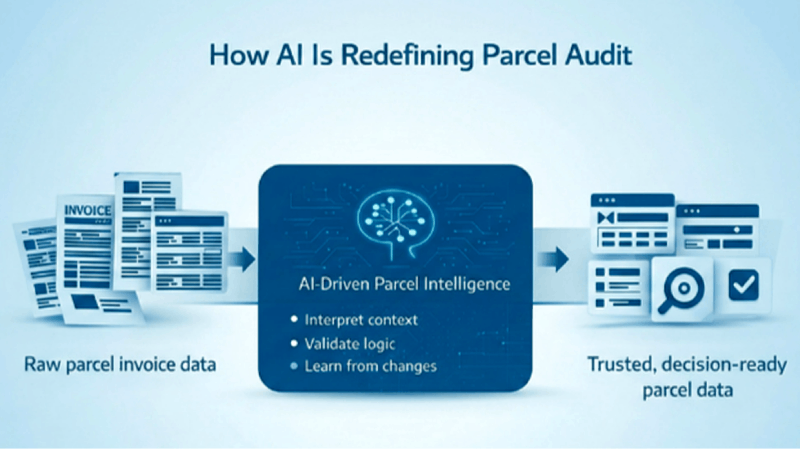
Modern parcel audit requires intelligence, not just extraction.
AI-driven data intelligence platforms, such as nSure AI Data Extraction within the nVision ecosystem, interpret parcel invoices in full operational and contractual context. They classify charges, validate dimensional and zone logic, normalize data, and continuously learn from evolving transportation provider behavior.
Instead of relying on static rules that require constant maintenance, AI adapts as pricing structures change. Parcel audit shifts from reactive refund identification to proactive data validation and insight generation.
The result is clean, trusted parcel data that can support analytics, transportation provider negotiations, and fulfillment strategy.
From Transaction Review to Parcel Intelligence
As parcel audit becomes integrated with analytics and procurement processes, its value expands. Validated audit data highlights patterns in dimensional weight impact, accessorial usage, service performance, and zone-based cost behavior.
Organizations gain earlier visibility into cost drivers, stronger enforcement of contract terms, and clearer insight into how parcel decisions affect overall fulfillment economics. Parcel audit becomes a feedback loop, informing strategy rather than simply validating transactions.
What once occurred quietly after billing now plays an active role in shaping future shipping decisions.
Final Thought
Parcel shipping may appear operationally simple, but at scale it is one of the most data-intensive components of the supply chain.
As volumes grow and pricing structures become more complex, parcel audit, powered by AI-driven data intelligence such as nVision Global’s nSure AI Data Extraction, is emerging as a foundational capability for organizations that want accuracy, visibility, and control.
For high-volume shippers, the smartest parcel strategies don’t start with renegotiation or new transportation providers, they start with intelligence at the invoice level.
The post Parcel Audit: The Overlooked Intelligence Layer behind High-Volume Shipping appeared first on nVision Global | Worldwide Supply Chain Solutions, Specializing in Global Freight Audit & Payment, Loss & Damage Claims, Supply Chain Services & Technology.
]]>